
 انضم لنا على فيسبوك
 جديد المنتدى
 تابعنا على تويتر
 تابع أعمالنا على يوتيوب
 تابعنا على جوجل بلاس
 تابعنا على اينستغرام
 تابعنا على بينتريست
 تابعنا على سكريبد
 تابعنا على سلايدشير
 تابعنا على ساوند كلاود
 تابعنا على تامبلر


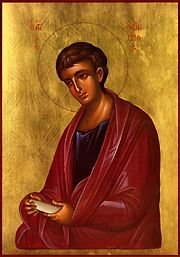
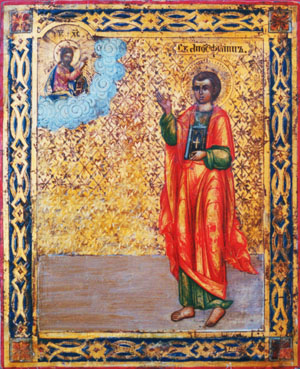
 Philip
[FRAME="13 70"]
Philip
He is the Apostle from Bethsaida who obeyed the call of
Jesus and led Nathaneal to Christ. At the feeding of the
5,000
people, Jesus said to Phillip to buy bread, and
Phillip answered Him, "Two hundred denarii would not buy enough bread for each of them to get a little."
Phillip
on another occasion asked Jesus, "Lord, show us the
Father" and Jesus retorted, "Yet you do not know me
Phillip?" Phillip the Apostle should not be confused with
Phillip, one of the seven Deacons. The Apostle Phillip
preached the Gospel in Asia and suffered crucifixion,
according to tradition
Saint Philip was born in a remote corner of the Holy Land, in a city named Bethsaida. This village is also the
birthplace of Saint Andrew as well. Philip, like the other
apostles of Christ, was assigned an area to which he would preach the word of Christ by the drawing of lots. To him fell the uninviting western area of the continent of Asia, or Asia Minor as it has been called. He assumed this responsibility with a confidence and humility born of the blessings of the Lord. He was more than ably assisted in this holy work not only by his devout sister Miriam, but by Apostle Bartholomew as well. Their efforts were assured success when the Lord chose to make saint Philip an instrument of miraculous power
He traveled the length and breadth of Asia Minor tirelessly preaching and doing good work. He then returned for a time to Greece, where, like Saint Paul before him, he preached
before throngs of Greeks in Athens. Then he brought
countless numbers of Hellenes into the Christian fold
with the assistance of Bartholomew and Miriam
Saint Philip's return to Asia was hastened by reports of
a strange Phrygian cult which had been introduced to the
superstitious and illiterate populace and which was in
direct conflict with the Christian doctrine and practice.
A snake of awesome size was being worshipped as a god, but
with greater reverence than a whole herd of sacred cows,
as in India. The colossal viper was said to be invincible,
a notion which vanished when Saint Philip strode up to the
creature and placed his hand on it causing it to perish on
the spot. This display brought the populace bask to its
senses and by thousands the Phrygians were baptized into
Christianity
To say this caused the pagan fanatics considerable
consternation would be quite an understatement.
The frightened pagans who were caused to change their
minds out of fear and bring down the holy trio from their
crosses were well aware of the Phrygian serpent, but that
only served to add confusion to their fear after a
profusely bleeding Saint Philip died. Probably the first
to be nailed to the cross and the last to be removed, the
Apostle Philip was beyond help and since it was his will
to die, there was no miracle forthcoming to save him. As
John Donne was to say centuries later, " shall not live
until I see God, and when I have seen Him I shall never
die," Philip undoubtedly was aware of this and was as
anxious to die as most are anxious to live. It is
preferred to believe that the Lord called him to his
side, since it is he who decides what the hour of death
shall be. Saint Philip was not weary of his travails and
certainly missionary work helped tremendously in laying
the foundation of the Church of the New Faith, along with
his fellow disciples and their associates, but for whom
Christianity might have expired. His sister and Saint
Bartholomew had been spared, but it was God's will that
they do so. Saint Philip, another brave disciple destined
to be dwarfed by Saint Peter, as well as the mighty
Apostle Paul, had thrust himself into the Christian cause
with equal vigor and devotion, and is revered as any of
his companions in Christ by the Orthodox Church.
The holy trio of Philip, Bartholomew, and Miriam, were
tried and condemned. The servants of God were sentenced
to be crucified. The death sentence was carried out with
dispatch and the holy three were nailed to wooden crosses
No sooner had this been done than the sky darkened and the
earth trembled violently from a rumbling earthquake. This
phenomenon struck terror into the hearts of those
responsible, who immediately sought to appease the wrath
of God by taking the intended victims down from their
crosses
Miriam and Bartholomew survived, but as though he had
willed his own demise so that his death might be on the
heads of his enemies, Saint Philip did not. His dying
gaze rendered the throng powerless and he bled to death
on November 14 with his last breath praising the Lord
[/FRAME]

 رد مع اقتباس

المفضلات