
 انضم لنا على فيسبوك
 جديد المنتدى
 تابعنا على تويتر
 تابع أعمالنا على يوتيوب
 تابعنا على جوجل بلاس
 تابعنا على اينستغرام
 تابعنا على لينكدين
 تابعنا على بينتريست
 تابعنا على سكريبد
 تابعنا على سلايدشير
 تابعنا على ساوند كلاود
 تابعنا على تامبلر


 رد: St Joseph The Damascene

Father Joseph versus Protestant
missionaries
Father Joseph had more than one confrontation with protestants. The most important ones were in the cities of Hasbaia and Rashaia, then in the city of Damascus. In the city of Hasbaia, the American Protestant missionaries had great success through their school which they had established in that city. More than a 150 persons converted to Protestantism, as a result of a conflict between the Orthodox people in those two cities. As an envoy of Patriarch Methodios, Father Joseph was able to bring back some of the straggling sheep to the Orthodox pen. After he refuted the missionaries several times, he succeeded to restraint them. In Damascus he strived in his pastoral care, preaching and guiding his people to the enlightenment and to fortify them against the circulating sects and heresies.
It is mentioned that an English missionary Grame used to meet Father Joseph and discuss Biblical issues with him. Realizing that this missionary was perverting the answers given by Father Joseph on the questions raised, he asked him to send their questions in a written form. In the beginning they thought that they had confuted him, after he neglected to answer- them. When they came in the beginning of the Great Lent, he answered all their questions accurately, until they returned amazed by the correctness of his knowledge and research. It is said that as a consequence of that incident they ended their missionary campaign on the Orthodox congregation; their questions were for inquiry and not for debate.
A great man of renaissance
Undoubtedly, Father Joseph was - in the 19th century greatest man of renaissance in the Antiochian Church. At that time, Antioch was in a pathetic situation: The schism of the Melkites led to very critical repercussions on different levels, especially on the pastoral level. The Protestant missionaries were very active and aggressive, while the Church was impotent and feeble, ignorant and poor. Starting from 1724, the hierarchs were foreign to the land and to the struggle of its people. Antioch lived under custodianship, under the pretext that she is going to disintegrate gradually and become Roman Catholic. In the name of Orthodoxy, both Constantinople and Jerusalem distributed among themselves the authority of appointing Antiochian bishops, trying to determine her destiny. At that time there were no competent priests, no pastoral care. The Antiochian Church could be described as a ship stricken by waves, and ready to sink ...In the midst of those challenges and dangers, Father Joseph bloomed as a new godly branch, having a great fervor toward God and the Church of Christ in the land...
Then, renaissance started... Father Joseph's life, fervor, godliness, poverty, love of knowledge, persisting pastoral care, preaching, guidance, writings, translations, school and vigilance created a revivalistic atmosphere, motivated the spirits, moved the hearts, and strengthened the determination. A new generation, a new thinking, and a new direction bloomed. "The bones came together, bone to its bone... and breath came into them, and they lived," (Ezekiel 37:7-10).
More than 50 church leaders studied under him, and became as watchful as he was: Patriarch Meletios Al-Doumani (+1906), First indigenous patriarch since 1724; Gabriel Shatila, Metropolitan of Beirut and Lebanon (+1901); the great scholar Garasimos Yared (+1899), Metropolitan of Zahle, Saidnaia and Maloula; and his students were more than ten bishops, as well as large numbers of priests, among them Archimandrite Athanasius Kaseer (+1863), founder of Balamand Seminary; Father Speredon Sarouf (+1858), dean of the clerical school in Jerusalem and editor of the publications of Holy Sepulcher; Archpriest John Doumai (+1904), founder of the Arabic publishing house in Damascus, in addition to some renowned laymen like Dimitiri Shahadeh, pillar of renaissance; Michael Klaila, administrator of the Patriarchal schools in Damascus; and Doctor Michael Mashakah (+1888). What he longed for Was accomplished during his lifetime and after his death; oftentimes he repeated: "I planted the seed in the true vineyard of Christ, and I am waiting for the harvest." All these things can be explained by the statement of Metropolitan Gabriel Shatila: "The stars of Damascus are three: The Apostle Paul, John of Damascus, and Joseph Mouhana Al-Haddad."
His life should be crowned with an ending equal to his godliness and great love, in which he would glorify God through his martyrdom.
His Martyrdom
On July 9, 1860, when the massacre in Damascus started, many Christians took refuge in the Patriarchal Cathedral (Al-Mariamieh); some came from the Lebanese cities of Hasbaia and Rashaia, where the massacre started and where killing took place. Others came from the villages around Damascus.
Following the tradition of the priests in Damascus, Father Joseph used to keep the Communion kit at his house. During the massacre of 1860 he hid his communion kit under his sleeves, and went jumping from one roof to another toward the Cathedral. He spent the whole night strengthening and encouraging the Christians to face the situation, for the attackers can kill the body but cannot kill the soul (Matthew 10:28); the crowns of glory have been prepared for those who committed themselves to God through Jesus Christ. In relating to them the martyrdom of some saints, he called them to emulate their life.
On Tuesday morning, July 10, the persecutors belligerently attacked the Cathedral, robbing, killing and burning everything. Many martyrs were slaughtered, others went out on the streets and alleys; one of them was Father Joseph. As he walked on the streets, a religious scholar-, who was one of the attackers, recognized Joseph, because the latter had confuted him in a debate between them. Seeing him he shouted: "This is the leader- of Christians. If we kill him, we will kill all the Christians!" When he heard these words, Father Joseph knew that his end had come. He took out his communion kit, and partook of the Body and Blood of Jesus Christ. The persecutors attacked him with their hatchets, as if they were woodcutters, and disfigured his body. Binding his legs with ropes, they dragged him over the streets until he was dashed into pieces.
Although he died as a martyr, his life, his vigilance, and his sufferings were a witness of his holiness. By "becoming like Him in His death" (Phil. 3:10), he was crowned with His glory. He became an example to be emulated, and a blessing to be acquired, and an intercessor to our Lord-d and Saviour Jesus Christ, to Him be the glory forever. Amen.
Through the prayers of HIEROMARTYR JOHN THE DAMASCENE and his companions
Lord Jesus Christ our God, have mercy on us and save us. Amen.
Translated by V. Rev. Fr. MICHEL NAJIM
Reprinted from the WORD; January, 1994, p21-26

 رد مع اقتباس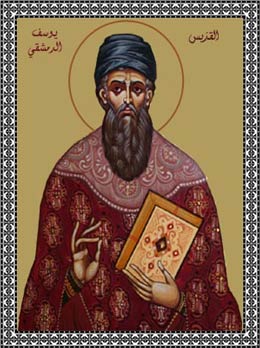




المفضلات