Frequent Reception of the Holy Mysteries is Beneficial
and Salvific
Part 1 of 2
Part II, Chapter 2 from Concerning Frequent Communion
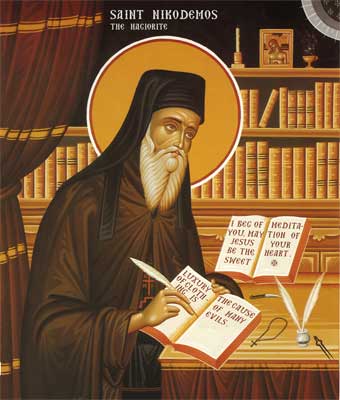
by St. Nikodemos the Hagiorite
What follows is the second of three chapters in Part II, "Concerning Frequent Communion." Take note of the other two chapter titles: "Is is necessary for the Orthodox to Partake frequently of the Divine body and blood of our Lord," and Infrequent Communion causes great harm
Both the soul and the body of the Christian receive great benefit from the divine Mysteries—before he communes, when he communes, and after he communes. Before one communes, he must perform the necessary preparation, namely, confess to his Spiritual Father, have contrition, amend his ways, have compunction, learn to watch over himself carefully, and keep himself from passionate thoughts (as much as possible) and from every evil. The more the Christian practices self-control, prays, and keeps vigil, the more pious he becomes and the more he performs every other good work, contemplating what a fearful King he will receive inside of himself. This is even more true when he considers that he will receive grace from Holy Communion in proportion to his preparation. The more often someone prepares himself, the more benefit he receives. p93
When a Christian partakes of Communion, who can comprehend the gifts and the charismata he receives? Or how can our inept tongue enumerate them? For this reason, let us again bring forward one by one the sacred teachers of the Church to tell us about these gifts, with their eloquent and God-inspired mouths.
Gregory the Theologian says
When the most sacred body of Christ is received and eaten in a proper manner, it becomes a weapon against those who war against us, it returns to God those who had left Him, it strengthens the weak, it causes the healthy to be glad, it heals sicknesses, and it preserves health. Through it we become meek and more willing to accept correction, more longsuffering in our pains, more fervent in our love, more detailed in our knowledge, more willing to do obedience, and keener in the workings of the charismata of the Spirit. But all the opposite happens to those who do not receive Communion in a proper manner. p94
Those who do not receive Communion frequently suffer totally opposite things, because they are not sealed with the precious blood of our Lord, as the same Gregory the Theologian says: “Then the Lamb is slain, and with the precious blood are sealed action and reason, that is, habit and mental activity, the sideposts of our doors. I mean, of course, by ‘doors,’ the movements and notions of the intellect, which are opened and
closed correctly through spiritual vision.” p95
St. Ephraim the Syrian writes
Brothers, let us practice stillness, fasting, prayer, and tears; gather together in the Church; work with our hands; speak about the Holy Fathers; be obedient to the truth; and listen to the divine Scriptures; so that our minds do not become barren (and sprout the thorns of evil thoughts). And let us certainly make ourselves worthy of partaking of the divine and immaculate Mysteries, so that our soul may be purified from thoughts of unbelief and impurity, and so that the Lord will
dwell within us and deliver us from the evil one
The divine Cyril of Alexandria says
That, because of divine Communion, those noetic thieves the demons find no opportunity to enter into our souls through the senses
You must consider your senses as the door to a house. Through the senses all images of things enter into the heart, and, through the senses, the innumerable multitude of lusts pour into it. The Prophet Joel calls the senses windows, saying: “They shall enter in at our windows like a thief” (Jl. 2:9), because these windows have not been marked with the precious blood of Christ. Moreover, the Law commanded that, after the slaughter (of the lamb), the Israelites were to smear the doorposts and the lintels of their houses with its blood, showing by this that the precious blood of Christ protects our own earthly dwelling-place, which is to say, our body, and that the death brought about by the transgression is repelled through our enjoyment of the partaking of life (that is, of life-giving Communion). Further, through our sealing (with the blood of Christ) we distance from ourselves the destroyer. p 96
The same divine Cyril says in another place that, through Communion, we are cleansed from every impurity of soul and receive eagerness and fervor to do good: “The precious blood of Christ not only frees us from every corruption, but it also cleanses us from every impurity lying hidden within us, and it does not allow us to grow cold on account of sloth, but rather
makes us fervent in the Spirit.” p97
St. Theodore the Studite wondrously
Describes the benefit one receives from frequent Communion
Tears and contrition have great power. But the Communion of the sanctified Gifts, above all, has especially great power and benefit, and, seeing that you are so indifferent towards it and do not frequently receive it, I am in wonder and great amazement. For I see that you only receive Communion on Sundays, but, if there is a Liturgy on any other day, you do not commune, though when I was in the monastery each one of you had permission to commune every day, if you so desired. But now the Liturgy is less frequently celebrated, and you still do not commune. I say these things to you, not because I wish for you simply to commune—haphazardly, without preparation (for it is written: ”But let a man examine himself, and so let him eat of the Bread, and drink of the Cup. For he that eateth and drinketh unworthily, eateth and drinketh damnation to himself, not discerning the Lord’s body and blood” [1 Cor. 11:28–29]). No, I am not saying this. God forbid! I say that we should, out of our desire for Communion, purify ourselves as much as possible and make ourselves worthy of the Gift. For the Bread which came down from heaven is participation in life: ”If any man eat of this bread, he shall live for ever: and the bread that I will give is My flesh, which I will give for the life of the world” (Jn. 6:51). Again He says: ”He that eateth My flesh, and drinketh My blood, dwelleth in Me, and I in him” John 6:58
Do you see the ineffable gift? He not only died for us, but He also gives Himself to us as food. What could show more love than this? What is more salvific to the soul? Moreover, no one fails to partake every day of the food and drink of the common table. And, if it happens that someone does not eat, he becomes greatly dismayed. And we are not speaking here about ordinary bread, but about the Bread of life; not about an ordinary cup, but about the Cup of immortality. And do we consider Communion an indifferent matter, entirely unnecessary? How is this thought not irrational and foolish? If this is how it has been up until now, my children, I ask that we henceforth take heed to ourselves, and, knowing the power of the Gift, let us purify ourselves as much as possible and partake of the sanctified Things. And if it happens that we are occupied with a handicraft, as soon as we hear the sounding-board calling us to Church, let us put our work aside and go partake of the Gift with great desire. And this (that is, frequent Communion) will certainly benefit us, for we keep ourselves pure through our preparation for Communion. If we do not commune frequently, it is impossible for us not to become subject to the passions. Frequent Communion will become for us a companion unto eternal life. p98
So, my brothers, if we practice what the divine Fathers have ordered and frequently commune, we not only will have the support and help of divine grace in this short life, but also will have the angels of God as helpers, and the very Master of the angels Himself. Furthermore, the inimical demons will be greatly distanced from us,
asthe divine Chrysostom says
Let us then return from that Table like lions breathing fire, having become fearsome to the devil, thinking about our Head (Christ) and the love He has shown for us…. This blood causes the image of our King to be fresh within us, it produces unspeakable beauty, and, watering and nourishing our soul frequently, it does not permit its nobility to waste away…. This blood, worthily received, drives away demons and keeps them far from us, while it calls to us the angels and the Master of angels. For wherever they see the Master’s blood, devils flee and angels run to gather together…. This blood is the salvation of our souls. By it the soul is washed, is made beautiful, and is inflamed; and it causes our intellect to be brighter than fire and makes the soul gleam more than gold....Those who partake of this blood stand with the angels and the powers that are above, clothed in the kingly robe itself, armed with spiritual weapons. But I have not yet said anything great by this: for they are clothed even with the King Himself. p99
Do you see, my beloved brother, how many wonderful charismata you receive if you frequently commune? Do you see that with frequent Communion the intellect is illumined, the mind is made to shine, and all of the powers of the soul are purified? If you also desire to kill the passions of the flesh, go to Communion frequently and you will succeed. Cyril of Alexandria confirms this for us: “Receive Holy Communion believing that it liberates us not only from death, but also from every illness. And this is because, when Christ dwells within us through frequent Communion, He pacifies and calms the fierce war of the flesh, ignites piety toward God, and deadens the passions.” p100
Thus, without frequent Communion we cannot be freed from the passions and ascend to the heights of dispassion; just as the Israelites, if they had not eaten the passover in Egypt, would not have been able to be freed. For “Egypt” means an impassioned life, and if we do not frequently receive the precious body and blood of our Lord (every day if it be possible), we will not be able to be freed from the noetic Pharaonians -- that is, the passions and the demons
According to Cyril of Alexandria, As long as those of Israel were slaves to the Egyptians, they slaughtered the lamb and ate the passover. This shows that the soul of man cannot be freed from the tyranny of the devil by any other means except the partaking of Christ. For He Himself says: ”If the Son therefore shall make you free, ye shall be free indeed” (John. 8:36). p101
Again St. Cyril says, “They had to sacrifice the lamb, being that it was a type of Christ, for they could not have been freed by any other means.” p102
So if we also desire to flee Egypt, namely, dark and oppressive sin, and to flee Pharaoh, that is, the noetic tyrant (according to Gregory the Theologian), [103] and inherit the land of the heart and the promise, we must have as our general (as the Israelites had Joshua [Jesus] the son of Nun as their general) our Lord Jesus Christ through the frequent reception of Communion. This way we will be able to conquer the Canaanites and the strangers, which are the disruptive passions of the flesh, and the Gibeonites, which are deceptive thoughts, in order that we may be able to remain in Jerusalem, which is interpreted “sacred peace” (as opposed to the peace of the world), as our Lord says: “My peace I give unto you: not as the world giveth, give I unto you” (Jn. 14:27). That is to say, My own peace I give to you, O my disciples, the sacred and holy peace, not the peace which is of the world, which oftentimes looks also to wickedness
Remaining in that sacred peace, we will be deemed worthy to receive inside our heart the promise of the Spirit, just as the Apostles remained and waited in Jerusalem, according to the command of the Lord, and received the perfection and grace of the Spirit on the day of Pentecost. And peace is a charisma which attracts all of the other divine charismata; and the Lord dwells in peace, as the Prophet Elias says, for God was neither in the powerful and strong wind, nor in the earthquake, nor in the fire, but in the gentle and peaceful breeze. p104
However, without the other virtues, one cannot acquire peace. And virtue cannot be achieved without keeping the commandments. And no commandment is perfected without love, and love is not renewed without divine Communion. Wherefore, without divine Communion, we labor in vain
Many obtain a variety of virtues on their own, thinking that they can be saved by these without frequent Communion, which is however fundamentally impossible. For they do not want to be obedient to the will of God and commune frequently, according to the norm of the Church, when they come together
at every festive Liturgy
To such people, God says through the Prophet Jeremiah: “They have forsaken Me, the fountain of living waters, and hewed them out cisterns, broken cisterns, that can hold no water” (Jer. 2:13). That is to say, ”They left Me, God, Who is the fount of the life-giving water, namely, the virtue and charismata of the Holy Spirit, and they dug out for themselves wells full of holes, which cannot hold water.” He again says through the Prophet Isaiah
Yet they seek Me daily, and delight to know My ways, as a nation that did righteousness, and forsook not the ordinance of their God. They ask of Me the ordinances of justice; they take delight in approaching to God. Wherefore have we fasted, say they, and Thou seest not? Wherefore have we afflicted our soul, and Thou takest no knowledge? Behold, in the day of your fast ye find pleasure, and exact all your labours. Behold, ye fast for strife and debate, and to smite with the fist of wickedness. Ye shall not fast as ye do this day, to make your voice to be heard on high. Is it such a fast that I have chosen? A day for a man to afflict his soul? Is it to bow down his head as a bulrush, and to spread sackcloth and ashes under him? Wilt thou call this a fast, and an acceptable day to the Lord? Is. 58:2–5
That is, ”They sought Me daily and desired to learn the wisdom of My providence, as if they were some righteous people which kept the ordinances of God. And they say: ‘Lord, why did You not see us when we fasted? Why do You not want to know that we underwent such hardship?’” And God answers: I do not hear you. For whenever you fast, you continue to do your wicked will. I do not want such a fast, nor such hardship. And even if you were to spread sackcloth and ashes on the ground beneath you like a bed, still I would not accept such a fast
However, when labors and virtues are done according to the will of God, then are they acceptable to Him and beneficial. The will of God is that we do whatever our Lord commands, Who says to us: “Whoso eateth My flesh, and drinketh My blood, hath eternal life” (John. 6:54). This is not only a commandment, but the chief of all of the commandments, for it is constitutive of
and perfects the rest of the commandments
To be continued in Part 2 of 2

 انضم لنا على فيسبوك
 جديد المنتدى
 تابعنا على تويتر
 تابع أعمالنا على يوتيوب
 تابعنا على جوجل بلاس
 تابعنا على اينستغرام
 تابعنا على بينتريست
 تابعنا على سكريبد
 تابعنا على سلايدشير
 تابعنا على ساوند كلاود
 تابعنا على تامبلر


 Holy Communion

 رد مع اقتباس



المفضلات