Warning: preg_replace(): The /e modifier is deprecated, use preg_replace_callback instead in ..../includes/class_bbcode.php on line 2958

Warning: preg_replace(): The /e modifier is deprecated, use preg_replace_callback instead in ..../includes/class_bbcode.php on line 2958

Warning: preg_replace(): The /e modifier is deprecated, use preg_replace_callback instead in ..../includes/class_bbcode.php on line 2958

Warning: preg_replace(): The /e modifier is deprecated, use preg_replace_callback instead in ..../includes/class_bbcode.php on line 2958

Warning: preg_replace(): The /e modifier is deprecated, use preg_replace_callback instead in ..../includes/class_bbcode.php on line 2958

Warning: preg_replace(): The /e modifier is deprecated, use preg_replace_callback instead in ..../includes/class_bbcode.php on line 2958

Warning: preg_replace(): The /e modifier is deprecated, use preg_replace_callback instead in ..../includes/class_bbcode.php on line 2958

Warning: preg_replace(): The /e modifier is deprecated, use preg_replace_callback instead in ..../includes/class_bbcode.php on line 2958

Warning: preg_replace(): The /e modifier is deprecated, use preg_replace_callback instead in ..../includes/class_bbcode.php on line 2958

Warning: preg_replace(): The /e modifier is deprecated, use preg_replace_callback instead in ..../includes/class_bbcode.php on line 2958
Archdiocese of Constantinople

الأعضاء الذين تم إشعارهم

صفحة 1 من 2 12 الأخيرةالأخيرة
النتائج 1 إلى 10 من 14

الموضوع: Archdiocese of Constantinople

  1. #1
    آباء الكنيسة الأرثوذكسية
    التسجيل: Jan 2008
    العضوية: 8488
    الإقامة: Lebanon
    الجنس: male
    العقيدة: الكنيسة الأرثوذكسية / روم أرثوذكس
    أُفضل في الموقع: غير ذلك
    الحالة: Fr. Boutros Elzein غير متواجد حالياً
    المشاركات: 1,962

    Array

    Mentioned
    0 Post(s)
    Tagged
    0 Thread(s)

    افتراضي Archdiocese of Constantinople

    [frame="13 98"]

    [glow=FFFF66]The Patriarchal Church of St. George [/glow][glow=FFFF66]
    [/glow]

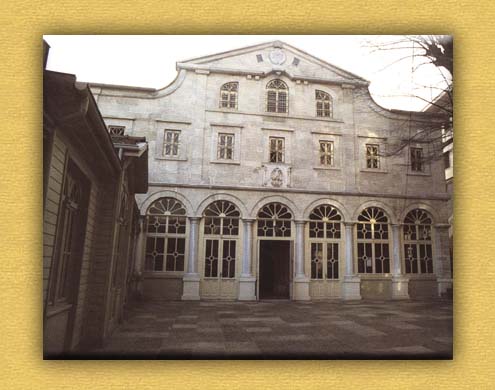
    Before the patriarchal cathedral was finally installed in the church of St. George at the Phanar in 1600, successive wanderings and shiftings had taken place. After the fall of Constantinople to the Turks, the Patriarch Gennadius Scholarius (1453-1456 and 1458-1463) sheltered the Patriarchate temporarily, from 1453 to 1456, in the precincts of the famous church of the Holy Apostles. Then the Patriarchate was installed more permanently at the historic monastery of Panagia Pammakaristos, where it remained for a period of 131 years, from 1456 to 1587. When the Pammakaristos was converted into a mosque - the Fethiye Camii - the Patriarchate was forced to move again and embark on new wanderings. It found temporary hospitality (1587-1597) at the church of the Theotokos Paramythia, which was a metochion (dependency) of the rulers of Bogdania (i.e. Moldavia and Wallachia) in Constantinople, the so-called «Palace of the Wallachians» or «Vlach Saray», and later (1597-1600) at St. Demetrios Kanabu by the Xyloporta. Finally, in 1600, in the patriarchy of Matthew II (1596, 1598-1602 and 1603), the Patriarchate was installed in the small convent of St. George at the Diplophanarion. The following list gives a picture of the wanderings and shiftings of the Ecumenical Patriarchate in the course of the centuries:
    Hagia Eirene: the «Old Patriarchates»
    Hagia Sophia: from the reign of Constantine the Great (315) to the Fall of Constantinople (1453)
    Church of the Holy Apostles in Nicaea: during the period of the Latin occupation of Constantinople (1205-1262).
    Church of the Holy Apostles: from 1453 to 1456.
    Monastery of the Pammakaristos: from 1456 to 1587.
    Church of the Theotokos Paramythia («Palace of the Wallachians» or «Vlach Saray»): from 1587 to 1597.
    Church of St. Demetrios by the Xyloporta: from 1597 to 1600.
    Church of St. George at the Phanar: from 1600 to the present.
    The patriarchal church of St. George underwent successive phases of reconstruction before being given its present form. The earliest source of information records the renovation of the ruined cells from 1600 to 1603, immediately after the move of the Patriarchate to its precincts: «...and many cells were renovated there for everyone's accommodation», as mentioned in a letter by the Patriarch Raphael II (1603-1608).
    A second attempt at improvement was made by the Patriarch Timothy II (1612-1620), who, in 1614, enlarged «the originally very small, modest and poor church of St. George».
    Dositheus, Patriarch of Jerusalem (1669-1707), writes on this occasion: «St. George, the church of the Patriarchate, was also burned in the reign of Sultan Ahmet. It so happened that the mosque located by the Hippodrome was being built at the time, and the king gave order to restore the burned church. So, the apprentice builder of the mosque came with the many Christian craftsmen who worked at the mosque and rebuilt the church as it stands now». This explains the extension made by Timothy II in 1614. For the third time, general repairs were made to the church under Callinicus II the Acarnan during his third patriarchy (1694-1702), for the building was «dilapidated with age» and its walls and roof were crumbling.
    In the early 18th century the Patriarchate and the surrounding area were destroyed by fire: «the whole Phanar and the Petricapi and then the great church and the patriarchal houses and all the nearby buildings of the Patriarchate were burned down» (Hypsilantis). Scholars (Mathas, Koumas, Bendotis, Sathas, Hypsilantis, Germanos of Sardes) do not agree on the exact date of this calamity for which they suggest the dates 1701, 1707, 1710 and even 1720. What is certain is that Jeremias III, Patriarch of Constantinople (1716-1726, 1732-1733), wrote on 26 August 1720, in a letter addressed to Neophytos, Metropolitan of Arta: «By the mercy and will of the All-Good God, the lords, may God grant them long life, were moved and they gave us permission to rebuild from the very foundations the holy church of our Patriarchal and Ecumenical Throne, and so we have started this building with the help of God...». In another letter addressed to the rulers of the Trans-Danubian principalities, he noted: «Your Highness has probably heard and knows that by the mercy of God the holy patriarchal church and the surrounding buildings are being reconstructed from the very foundations...». The purpose of Jeremias's letters had been to request financial aid in order to defray the expenses for the great project of rebuilding the «Patriarchal Church and House».
    Bendotis gives the notable information that as soon as the construction of the church was completed, «the roof collapsed because it was domed», and so the Patriarch reconstructed the roof «in the form it has today». It was then (1720) that the building next to the church, «the mansion of the archontes» (Bendotis), was purchased to «serve as residence for the Patriarch» (Koumas). The restoration works initiated by Jeremias III were continued by the erudite Patriarch Paisius II (1726-1732, 1740-1743, 1744-1748, 1751-1752), as indicated by the date 1746 inscribed on most of the Despotic icons of the templon.
    An inscription on the lintel of the south door of the narthex records the great work of the reconstruction of the patriarchal church under Jeremias III:
    «Ὁ πάνσεπτος οὗτος καὶ Πατριαρχικὸς Ναὸς ἀνῳκοδόμητο ἐκ βάθρων αὐτῶν ἐπὶ τῆς πατριαρχείας τοῦ σεβασμιωτάτου Πατριάρχου κυρίου Ἱερεμίου, ἀναλώμασι μὲν καὶ δαπάνῃ τῶν εὐσεβῶν χριστιανῶν, ἐπιτροπευόντων δὲ καὶ ἐπιστατούντων τῶν πανιερωτάτων μητροπολιτῶν Νικομηδείας κυρίου Παϊσίου, Νικαίας κυρίου Γερασίμου, Χαλκηδόνος κυρίου Παρθενίου, Προύσσης κυρίου Κυρίλλου, Βάρνης κυρίου Καλλινίκου συνεπιστατούντων δὲ τῶν τιμιωτάτων ἀρχόντων τοῦ τε μεγάλου ἐκκλησιάρχου κὺρ Κωνσταντίνου καὶ Χατζῆ κὺρ Κωνσταντίνου, πρώην καπὶ Κεχαγιᾶ Οὐγγροβλαχίας. ΑΨΚ´ δεκεμβρίω ιη'».
    («This holy patriarchal church was rebuilt from its foundations in the patriarchy of the Most Reverend Patriarch Jeremias, at the expense of the devout Christians and under the superintendence and supervision of the Right Reverend Metropolitans Paisius of Nicomedia, Gerasimus of Nicaea, Parthenius of Chalcedon, Cyrillus of Brusa, Callinicus of Varna, with the assistance of the most honourable archontes Kyr Konstantinos the Great Ecclesiarch and Hatzi Kyr Konstantinos former Governor of Ungro-Wallachia. 18th December 1720»).
    A second, small, inscription on the inner side of the main entrance reads:
    «Μνήσθητι Κύριε τοῦ δούλου σου Κωνσταντίνου καπουκεχαγιᾶ τῆς Μολδοβλαχίας, οὗ τοῖς ἐξόδοις ἀνηγέρθη ἡ παροῦσα πύλη ἔτει ,αψκ´».
    («Remember, Lord, Thy servant Konstantinos, Governor of Moldavia and Wallachia, at whose expense this doorway was built in the year 1720»).
    A third, stone-carved, inscription on the right jamb of the main doorway tells us that the floor of the church was paved with slabs in the same year (1720):
    «Τὸ παρὸν ἔδαφος ἐστρώθη διὰ δαπάνης τοῦ τιμιωτάτου ἄρχοντος κυρίου Ἀθανασάκη Κιουρτσήμπασι εἰς μνημόσυνον αὐτοῦ ἐν ἔτει ,αψκ´, ἐν μηνὶ δεκεμβρίῳ γ´».
    («This floor was paved at the expense of the most honourable archon Athanasakis Kiourtsibasis in his remembrance. 3rd December 1720»).
    In the great fire of 1738, when the Patriarchate suffered severe damage, «by God's mercy, the church, the clerics' cells and the Synodicon were not gutted» (Hypsilantis). It was some sixty years before large-scale operations for the restoration of the Patriarchate were begun in 1797, in the patriarchy of Gregory V. In 1798, certain consolidations and additions were made to the patriarchal church and especially the sanctuary, where for the first time another two Holy Tables were set up. It was then decided to dedicate the right (south) aisle of the church as a parecclesion to St. Euphemia and the corresponding left (north) aisle as a parecclesion to the Three Hierarchs. We are indebted for this information to the writings of Koumas, Sathas, Vapheidis, Mathas, and the earlier historian Sergios Macraios, who expresses disagreement with the setting-up of three Holy Tables: «So he began to build the Patriarchal House in September of that year (1797)... then (1798) he tried to embellish the church of St. George the Great Martyr... by setting up three altars in the sanctuary and proceeding to the innovation of dedicating the right aisle to St. Euphemia and the left to the Three Hierarchs».
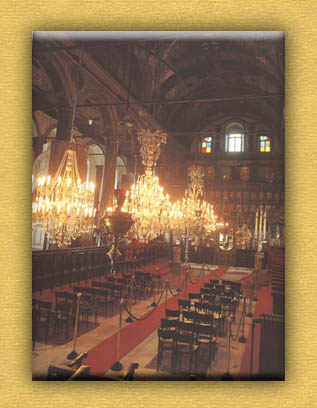
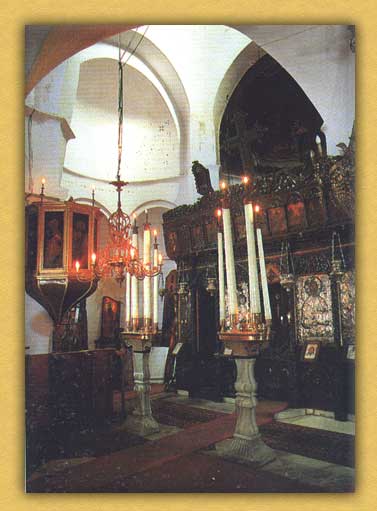
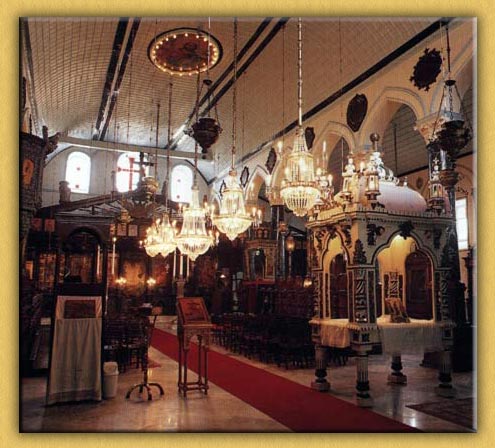
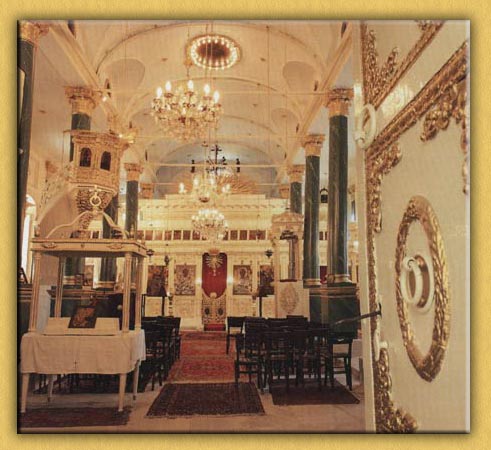
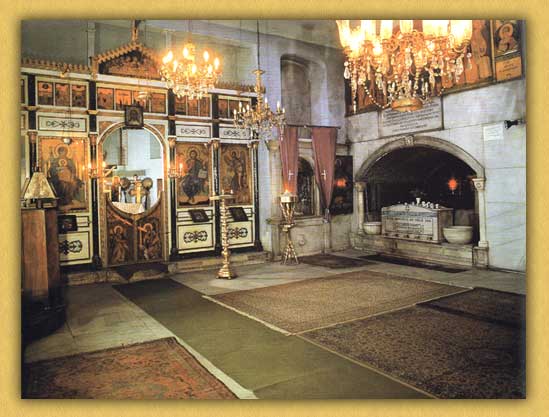
    In its present form the patriarchal church of St. George has the plan of a three-aisled basilica with three semicircular apses on the east side and a transverse narthex on the west. Owing to the irregularity of the site, the lateral walls are not straight but form a slight angle - a feature that does not affect the general plan of the church. The interior is divided into three aisles by colonnades, with the tall pews of ebony wood placed along the line of the columns. This arrangement leaves ample space in the nave for the performance of essential parts of the Liturgy - whether an ordinary Liturgy or one conducted by the Patriarch and members of the Holy Synod-on the «solea» until the completion of the Unbloody Sacrifice on the altar.
    In the holy bema, behind the altar, the synthronon is arranged in a semicircle along the curved wall of the apse, with seats for the Archpriests and a central higher throne of marble for the Patriarch.
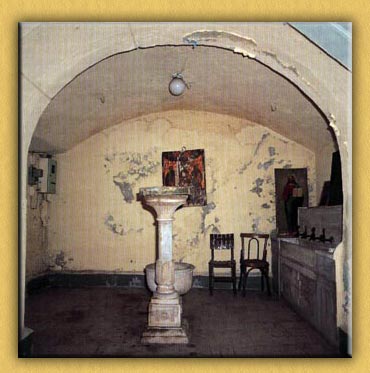
    As already mentioned, the diakonikon (to the south) has been converted into a parecclesion of the Pammakaristos, while the prothesis (to the north) has been dedicated to the Three Great Fathers of the Church. A narrow passage leads from the latter to a small sacristy and from there to the courtyard of the church
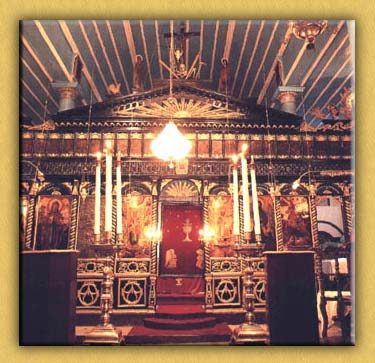
    A high wood-carved iconostasis separates the sanctuary from the nave. The valves of the Beautiful Gate are crowned with the eternal symbol of the Patriarchate, the two-headed eagle. The icons are in the following order: on the right side of the templon, Christ as «the True Vine», St. John the Baptist, the Saints George and Demetrios, the mosaic icon of Panagia Pammakaristos, St. Euphemia, and on the south wall, the mosaic icon of the Forerunner on an icon-stand, St. Spyridon, the Descent into Hell, St. Nicholas; on the left side of the templon, the Holy Virgin as «the Tree of Jesse», St. George on horseback, St. Nicholas, the Virgin and Prophets, the Three Hierarchs, and on the north wall, St. Charalampos, St. John the Evangelist and Prochoros, St. Menas on horseback, the Virgin Phaneromene of Cyzicus on an icon-stand, the Virgin of Artake, Christ Pantocrator. On the parapet of the women's gallery, from the south to the north wall, a series of 19th same time it was decided to honour also the Virgin Pammakaristos in the parecclesion of the south aisle, since her celebrated mosaic icon was placed there. Besides, it had been instituted from earlier times to dedicate the patriarchal church also to the Panagia Pammakaristos. Meletios of Athens reports that Timothy II, Patriarch of Constantinople, «decreed in 1614, that the new Patriarchate's church of St. George was to be dedicated also to the Ever-Virgin St. Mary, in memory of the previous patriarchal church of the Pammakaristos».
    Important modifications were made to the patriarchal church under Gregory VI (1835-1840). The church retained the length and width it had since the time of Jeremias III (1720), but the roof was raised to its present height. Until then the church had been «small, low and dark» (Koumas), with its height reaching up to where the ambo is now. The plans and surveillance of the modifications were entrusted to the architect Hatzi-Nicolis. The marble doorway with the ornamental door-frames and the neo-Classical lintel has given a monumental and majestic appearance to the entrance from the narthex to the church proper. This renovation is recorded in the inscription of Homeric style carved on the lintel above the main entrance to the church. The inscription includes the honourary mention of the name of Gregory VI, the date 1836, and a praise to the beauty of the renovated church
    The last large-scale embellishing operations were carried out by the Patriarch Joachim III (1878-1884, 1901-1912) over the whole area of the Patriarchate.
    In the patriarchal church, in particular, the marble pavement of the sanctuary was replaced, the synthronon was renovated, marble caskets were made for the depositing of the holy relics, the icon-frames were repaired and the ecclesiastical collection was enriched with liturgical vessels and vestments, all donated by the faithful.
    In August 1904, the Patriarch and the Holy Synod decided to celebrate jointly the Indiction Feast Day (1st September) and the worship of the ancient and miraculous icon of Panagia Pammakaristos. A special Service was composed for this occasion («Service of Vespers, Matins and Liturgy of the Feast of the Pammakaristos, Patriarchal Press at Constantinople, 1905»). This remains in force to our days, and the choir chants in a 4th plagal tone the apolytikion of the Pammakaristos.
    century oil-paintings on canvas executed in a westernizing style show scenes from the Old and the New Testament (from the Nativity to the Anastasis).
    The caskets with the holy relics of the three female saints, Euphemia, Solomone and Theophano, first consort of the Emperor Leo VI the Wise, have been placed on marble bases by the south wall of the parecclesion of the Pammakaristos.
    The larnax (casket) of St. Euphemia has a richly ornamented silver revetment. A †††††††† preserved in the archives of the Patriarchate (Cod. A, 46) records that in the patriarchy of Gabriel III (1702-1707), notably on the 11th July 1707, the Russian Ambassador to the Porte donated a quantity of cypress wood for the fashioning of three caskets in which to deposit the sacred relics of the three holy women. As a special honour to St. Euphemia, who suffered martyrdom under Diocletian, the Patriarch decreed «her feast-day to be celebrated annually with a procession in the patriarchal church and with her holy relics placed in the middle», as stated in the apodeixis sent to the Christians of Constantinople (Cod. A, 25-26).
    At the south wall also, next to the mosaic icon of the Forerunner, stands part of the Column of Flagellation, i.e. the column to which Christ was bound and flogged.
    The choirs of chanters are in the conventional places, in the central part of the church, and have superb lecterns inlaid with mother-of-pearl and adorned with icons (the lecterns were transported on 22nd August 1712 from the monastery of Panagia Kamariotissa at Halki). The Patriarchal thronos stands prominent, with the parathronion to the right for the Great Protosyncellus who officiates in the absence of the Patriarch, and the official throne-like pews for the members of the Holy Synod to the left. Across the nave, on the opposite side where the Princes of Moldavia and Wallachia stood in the old days, are the pews for the dignitaries, state officials and representatives of other denominations.
    The ambo is placed high on the third column of the northern colonnade. The pews for the congregation are lined along the north and south walls and the west side of the nave, while, to the west, is the women's gallery extending partly to the north. The old candle-stand, placed by the north entrance, is made of walnut wood and decorated with inlays of ††††l and ivory. An inscription in ivory on the side of the candle-stand tells us that it was donated to the patriarchal church in 1669 by Manuel, son of Peter, from Castoria.
    The donor may well have been the renowned Manolakis of Castoria, who had founded and endowed schools in Chios, Arta, Aetolikon and elsewhere.
    Today, the suspended large silver oil-lamps, the crystal chandeliers, the solemn patriarchal throne, the rows of-ebony pews, the old high templon with the elaborate wood-carvings, sanctified by ancient icons showing the marks of time, the historic mosaic icon of Panagia Pammakaristos and the icon from Cyzicus of Panagia Phaneromene with the wounded face, compose the picture of the patriarchal church expressing the measure of austerity which constitutes in matters of essence the very ethos and glory of Orthodoxy.
    In addition to its historic and sacred character, the patriarchal church has preserved some precious relics of the past, like the Patriarch's throne, the ambo and the icons.
    Athanasios Paliouras

    [/frame]

    †††التوقيع†††


    اترك لكم كلماتي
    وآخذ معي ذكرياتي معكم ، ومحبة الإخوة .
    والرب يرمم ماسقط مني سهواً أو عن ضعف .
    فما اردت يوماً ان اكون
    سوى ماكنتهُ وكما انا
    خادماً لأحباء يسوع
    وغاسل ارجل .

    -------------------


  2. #2
    آباء الكنيسة الأرثوذكسية
    التسجيل: Jan 2008
    العضوية: 8488
    الإقامة: Lebanon
    الجنس: male
    العقيدة: الكنيسة الأرثوذكسية / روم أرثوذكس
    أُفضل في الموقع: غير ذلك
    الحالة: Fr. Boutros Elzein غير متواجد حالياً
    المشاركات: 1,962

    Array

    Mentioned
    0 Post(s)
    Tagged
    0 Thread(s)

    افتراضي رد: Archdiocese of Constantinople


    [glow=FFFF00]The Church of Panagia of Blachernæ[/glow]

    The best known and most celebrated shrine of the Holy Virgin in Constantinople was the church of Panagia of Blachernæ. The history of the shrine, the fame of which had spread throughout the Christian world, extends over the entire Byzantine era, and the great events associated with it are linked with the history of the City.
    The first church at the site of the sacred spring was built and decorated by the Augusta Pulcheria between 450-453 (the year of her death) and her husband, the Emperor Marcian (450-457). The church was completed and embellished further by the Emperor Leo I (457-474), who added the Hagiasma (fountain of holy water) and the Hagion Lousma (sacred bath). Leo I also built the parecclesion of the Hagia Soros to house the holy mantle and robe of the Virgin that had been brought from Palestine to Constantinople in 473. It was then that the church was endowed with large estates. Procopius writes that Justinian, during the reign of his uncle Justin I (518-527) had altered and improved the original building. Procopius's description suggests that the basilica was given a dome supported by columns forming a semicircle. This renovation is mentioned in two epigrams of the Palatine Anthology.
    At times, Emperors showed their personal interest for the church by making donations and adding new constructions and decorations. Justin II (565-578) added two apses remodelling the plan into a trefoil transept, and some centuries later Romanus III Argyrus (1028-1034) decorated with gold and silver the intrados of the arches. A measure of the importance of the shrine is found in Emperor Heraclius's Near a, which appoints a total of 74 persons to the service of the church: 12 presbyters, 18 deacons, 6 deaconesses, 8 sub-deacons, 20 readers, 4 chanters and 6 doorkeepers.
    The role played by the Panagia of Blachernæ during the Iconoclast crisis, particularly in the reign of Constantine V, should be stressed. Like the Hagia Sophia, this church was a centre of Orthodox worship where every Friday an all-night vigil was dedicated to the miracle-working icon of the Virgin. Because of this, the whole iconographic programme of the church was destroyed by the iconoclasts. In the Life of St. Stephen the Younger, a contemporary work written in 808, it is recorded that the iconoclasts replaced the images of Christ, the Virgin and Saints with representations of trees, birds and animals: «Having ruined the venerated church of the Immaculate Theotokos of Blachernæ, the walls of which had been painted with varied iconographic subjects from God's Incarnation and His many Miracles to His Ascension and the Descent of the Holy Spirit, thus exalting Christ's mysteries, they turned it into a place of fruit-storing and ornithoscopy. They decorated it, to tell the truth indecorously, with all kinds of trees and birds and wild beasts and other animals within roundels of ivy-leaves, and cranes and crows and peacocks».
    The disappearance of the historic icon of the Virgin, painted on wood and revetted with gold and silver, is dated to those years. According to tradition, the icon was discovered hidden behind a wall in 1030, when the Emperor Romanus III Argyrus was renovating the church.
    The iconographic type of the Virgin Blachernitissa was already established by then and had spread throughout the Christian world. In this depiction the Mother of God is portrayed full-length in a frontal attitude, Her hands raised in prayer. The figure of Christ making the sign of blessing is painted within a medallion on Her breast. The icon of the Virgin Blachernitissa is associated with the miracle of the veil that covered the Virgin's face and was raised on certain occasions, as recorded in the writings of Anna Comnena.
    In 1070 a fire destroyed the church, which was rebuilt by the Emperors Romanus IV Diogenes (1067-1071) and Michael VII Ducas (1071-1078). The entire complex of buildings was ruined in 1434, shortly before the Conquest, when «some young noblemen wishing to catch nestlings» (G. Phrantzes) climbed on the roof and inadvertently started a fire.
    The best known and most significant historic event occurred in 626, when Constantinople was besieged by the Avars while Emperor Heraclius and his troops were campaigning against the Persians in Asia Minor. The icon of the Virgin Blachernitissa was carried along the battlements in a procession headed by the son of the absent Emperor and the Patriarch Sergius (610-638). The Avars raised the siege and the saving of the City was attributed to the direct intervention of the Mother of God. The entire population gathered at the church with the famous icon and in an all-night vigil they sang standing the Akathistos Hymn in praise of the Virgin Mary.
    In 834 the Iconoclast movement collapsed and the Feast of Orthodoxy commemorating the restoration of icons was celebrated for the first time at the church of Blachernæ. Tradition has it that in 944 the image of Christ (known as the Holy Mandylion) and the letter of King Abgar were brought from Edessa and placed in the parecclesion of the church.
    After 1204 the shrine passed into the hands of the Latins until John III Ducas Vatatzes (1222-1254), Emperor of the Nicaean Empire, purchased from the Catholics the church of Panagia of Blachernæ along with many other monasteries of Constantinople. In 1348 Genoese pirates caused damages to the shrine.
    From the surviving sources we learn that the church of Blachernæ was located near the shore of the Golden Horn, outside the city walls. To protect it, Emperor Heraclius built a defence wall around the shrine. Later, when the Palace of Blachernæ was erected further up on the slope of the hill, a special gate and stairway connected the church with the Palace. Emperors often attended services at the Panagia of Blachernæ and showed their interest and respect for the shrine in many ways. Campaigning Emperors are known to have carried an icon of the Panagia of Blachernæ and a great number of imperial seals bear the image of the Blachernitissa.
    The litany celebrated every Friday at the church of St. Mary in the Chalkopratiae with the icon of the Virgin Blachernitissa had been established since the time of the Patriarch Timothy I (511-518). Some other feast-days were commemorated with special pomp at the church of Blachernæ: The Presentation of Christ in the Temple (2nd February), the Feast of Orthodoxy (First Sunday of Lent), Good Friday, Easter Tuesday, the ceremony for the Virgin's Veil (2nd July), the consecration of the church (31st July), the saving of the City from the Avars and the Persians (7th August), the Dormition of the Virgin (15th August) and the event of the terrible earthquake of 740 (26th October).
    The shrine of Blachernæ, «the great church» as it is called in written sources, was composed of three buildings: the main church, the parecclesion of the Hagia Soros and the Hagion Lousma.
    The church was a three-aisled basilica with a timber roof, like the similar churches of Panagia in the Chalkopratiæ and of St. John the Baptist of Studius. It appears that after its destruction by fire in 1070, the church was rebuilt on the same plan. The interior decoration consisted of marble revetments to about half the height of the walls, columns of green jasper, and a finely worked gold and silver ceiling. The upper parts of the walls were decorated with wall paintings and mosaics depicting scenes from the Christological cycle. The silver ambo was placed at the centre of the nave and the splendid iconostasis was most impressive. Information on the magnificent iconography and the general decoration of the church has been preserved in the writings of the Spanish ambassador De Clavijo, who visited Blachernæ in 1402, and in a later work entitled Lament on the disappearance of the splendid church, by Isidore of Kiev (1385-1463).
    The parecclesion of the relics, known as parecclesion of the Hagia Soros, was a circular structure with a narthex, built to the south of the sanctuary of the main church. In addition to the mantle, veil and girdle of the Holy Virgin, it contained the venerated relics of many saints. Russian pilgrims of the 14th and 15th century describe the relics and mention those of St. Patapios, St. Athanasius, St. Pantaleon and St. Anastasia.
    The Hagion Lousma, a domed structure communicating with the parecclesion, included the apodyton (vestry), the kolymbos (basin) and St. Photeinos. Its walls were decorated with icons, with that of the Virgin placed in a special niche. Every Friday the Emperor bathed in the basin. Written sources provide detailed descriptions of the bathing ceremony: «... finally they enter St. Photeinos in the innermost part of the domed structure and light tapers in front of the marble icon of the Theotokos, from whose hands the holy water flows out...».
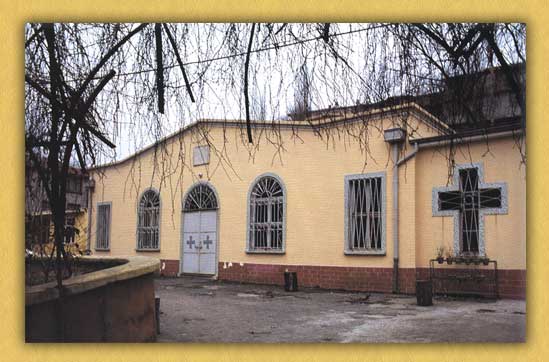
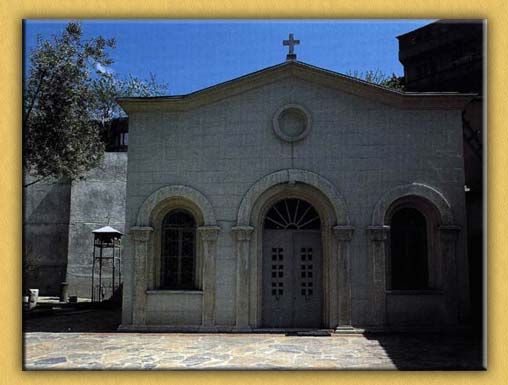
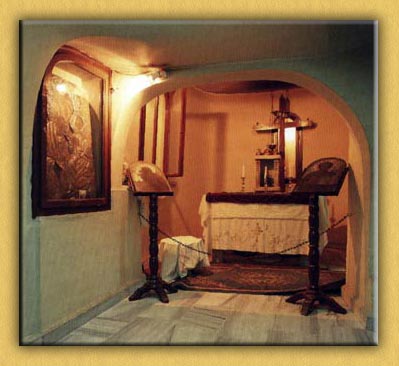
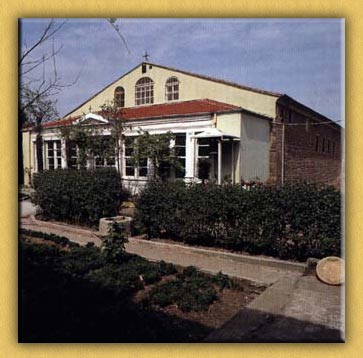
    After the destructive fire of 1434 and the Fall of Constantinople, nothing remained from the once rich and famous shrine except for the site of the Sacred Spring. The place passed into Ottoman hands until 1867, when it was purchased by the Guild of Greek Orthodox Furriers, who built a small church containing the hagiasma. As time went by, the Ecumenical Patriarchate made certain additions and the ancient sacred enclosure was given the aspect it has today. In the small church, the four wall paintings by Eirenarchos Covas (1964) above the hagiasma are reminders of great moments in the history of the Orthodox Church.
    Future excavations in the wider area of the Panagia of Blachernæ may lead to the discovery of the ruins of the great Byzantine church.
    Athanasios Paliouras
    †††التوقيع†††


    اترك لكم كلماتي
    وآخذ معي ذكرياتي معكم ، ومحبة الإخوة .
    والرب يرمم ماسقط مني سهواً أو عن ضعف .
    فما اردت يوماً ان اكون
    سوى ماكنتهُ وكما انا
    خادماً لأحباء يسوع
    وغاسل ارجل .

    -------------------


  3. #3
    آباء الكنيسة الأرثوذكسية
    التسجيل: Jan 2008
    العضوية: 8488
    الإقامة: Lebanon
    الجنس: male
    العقيدة: الكنيسة الأرثوذكسية / روم أرثوذكس
    أُفضل في الموقع: غير ذلك
    الحالة: Fr. Boutros Elzein غير متواجد حالياً
    المشاركات: 1,962

    Array

    Mentioned
    0 Post(s)
    Tagged
    0 Thread(s)

    افتراضي رد: Archdiocese of Constantinople


    The church of Panagia Mouchliotissa

    The church of Panagia Mouchliotissa is located at the Phanar quarter, between the Megale Schole and the Joachimian Girls School, not far from the Metochion of the Holy Sepulchre. In older days the origin of the church's name had given rise to a minor philological argumentation. S. Kugeas maintained that the name derived from Mouchlion, at Mystra, the inhabitants of which had settled in this area of the Phanar quarter in 1242. H. Gregoire, M. Lascaris and Gennadios Metropolitan of Heliopolis, believed that it is the Greek rendering of the Slavonic word mogyla. Indeed, the church was known by the names «St. Mary of the Mongols or Mougouls» and more commonly «Panagia of Mouchlion or Mouchliotissa» (Paspatis).
    The history of the church provides the answer. Maria Palaeologina, daughter of Michael VIII Palaeologus (1261-1282), was given in marriage to the Khan of the Mongols, Hulagu or Abagu (Pachymeres). After the death of her husband she returned to Constantinople and founded the convent and church, probably in 1285. The founding of the convent is mentioned in the Paris Codex Gr. 2625.
    According to written sources, the convent of Mouchlion was built on the site of an earlier monastery dedicated to the Theotokos Panagiotissa, which had been ruined, apparently by the Latins (Pasadaios). Maria Palaeologina bought the grounds with the vineyards and whatever structures existed, repaired some of them, erected new ones, and organized the women's convent. She endowed the monastery with relics, valuable vessels, manuscripts, lands in Constantinople and Rhaedestus, spending all her fortune. This information is obtained from a synodical †††††††† of 1351 (Miklosich and Müller, vol. I, 312-15), according to which the Ecumenical Patriarchate decreed the restitution to the monastery of the entire fortune seized by the usurper brother-in-law of Maria Palaeologina, Isaac Palaeologus-Asen. Asen, whom Maria had appointed by a chrysobul trustee of the monastery's properties after her death, used the revenues to his own advantage and the convent was facing dire poverty.
    After the Conquest, Mehmet II made a present of the church to the Greek architect Christodoulos, as a reward for the construction of the Mosque of the Conqueror (Fatih Camii) at the site of the demolished church of the Holy Apostles. The firman issued by Mehmet the Conqueror saved the church from being converted into a mosque under Selim I, and the Panagia Mouchliotissa has remained an Orthodox church to this day.
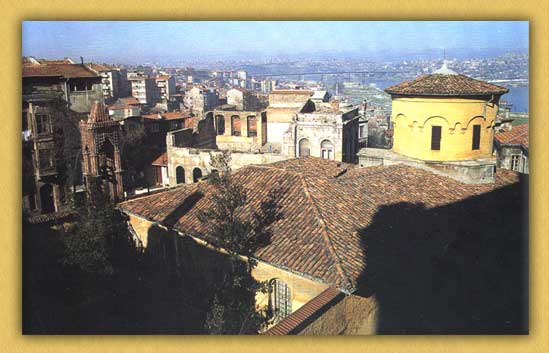
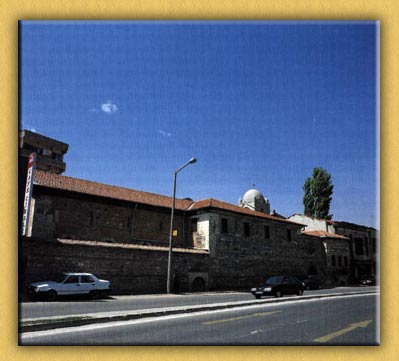
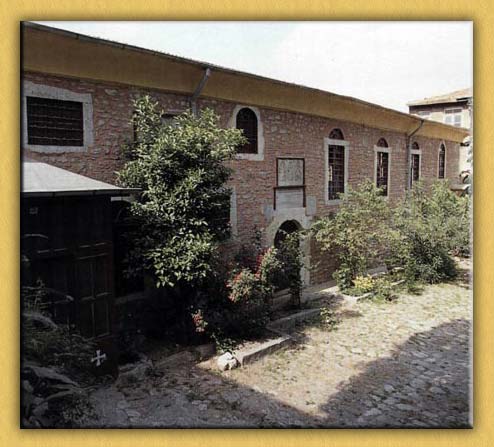
    The church, of irregular plan, stands within an enclosure with a small courtyard. Its most remarkable architectural feature is the elegant dome supported by four piers, though its size is rather disproportionate to the dimensions of the building. The apse to the east has survived, while traces of a second apse to the north reveal the old triconchial plan of the sanctuary. The entire south side was enlarged in later times to create a rectangular chamber with a cross-vaulted roof. Some traces from a representation of the Last Judgment are the only remnants of the old painting decoration of the church. An annotation on the manuscript of Suidas's Lexicon (Paris Codex Gr. 2625) informs us that the church was painted by Modestus in the late 13th century.
    In addition to the mosaic icon of Panagia Mouchliotissa, dated by Soteriou to the late 13th-early 14th century, another four post-Byzantine icons are notable: St. Paraskeve (1.35x0.40 m.) St. Euphemia (1.35x0.40 m.), the Three Hierarchs (1.25x0.60 m.) and the Sts. Theodoroi (1.27x0.54 m.). The belfry in the courtyard is of later date.

    Athanasios Paliouras


    †††التوقيع†††


    اترك لكم كلماتي
    وآخذ معي ذكرياتي معكم ، ومحبة الإخوة .
    والرب يرمم ماسقط مني سهواً أو عن ضعف .
    فما اردت يوماً ان اكون
    سوى ماكنتهُ وكما انا
    خادماً لأحباء يسوع
    وغاسل ارجل .

    -------------------


  4. #4
    آباء الكنيسة الأرثوذكسية
    التسجيل: Jan 2008
    العضوية: 8488
    الإقامة: Lebanon
    الجنس: male
    العقيدة: الكنيسة الأرثوذكسية / روم أرثوذكس
    أُفضل في الموقع: غير ذلك
    الحالة: Fr. Boutros Elzein غير متواجد حالياً
    المشاركات: 1,962

    Array

    Mentioned
    0 Post(s)
    Tagged
    0 Thread(s)

    افتراضي رد: Archdiocese of Constantinople


    Holy Shrine of the Virgin Vefa

    The Church of the Mother of God and the Aghiasma known as Vefa stand opposite the Comnenian monastery of the Pantocrator. In Byzantine times the quarter was called “Ta Sophrakiou”, but later it became Vefa Meidan, taking the name of a distinguished Turkish poet, Seyh eb ul Vefa.
    According to legend, Constantine Palaeologus, the last emperor of Byzantium, is buried in Vefa Square in an "invisible and insignificant" grave, besides which is the grave of the Arab who killed him. Tradition relates that as he fell Constantine cried out "μ' έφαγες!" ("You've done for me!"), the name 'Mepha' and thence 'Vefa' deriving from his last words.
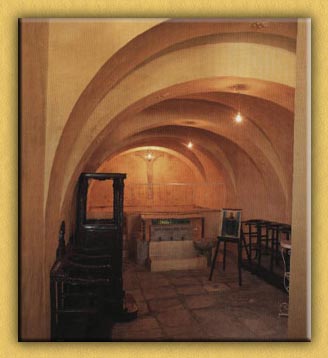
    The church was demolished after the Fall in 1455 and a garden was laid out on the site. In 1750 the garden was bought by an Epirote one of many thousands who left the craggy mountains of continental Greece to seek their fortune in the City. His daughter had a dream that there was an Aghiasma on the property and followed her father to Constantinople to persuade him to search fork. Excavations in 1755 revealed the passage-way and reservoir as well as a marble icon dated 1080. On the death of the Epirote and his daughter the Aghiasma passed to his heirs. Over the years it was purchased from them by the Macedonian Educational Brotherhood of Constantinople, which carried out extensive repairs and alterations. Twelve steps lead down from the church to the Aghiasma. It is said that in addition to a number of ex-votos preserved there, the marble icon, now broken, is kept there in a bronze casket.
    Here too, as at Blachernæ, on the first day of every month Turks, both men and women, wait patiently in line with Christians to collect some holy water which they sprinkle about their homes and shops. On New Year's Eve the queue stretches to even a kilometre in length.

    Ismini Kapandai


    Churches in Constantinople


    Nikos Ghinis – Constantinos Stratos


    †††التوقيع†††


    اترك لكم كلماتي
    وآخذ معي ذكرياتي معكم ، ومحبة الإخوة .
    والرب يرمم ماسقط مني سهواً أو عن ضعف .
    فما اردت يوماً ان اكون
    سوى ماكنتهُ وكما انا
    خادماً لأحباء يسوع
    وغاسل ارجل .

    -------------------


  5. #5
    آباء الكنيسة الأرثوذكسية
    التسجيل: Jan 2008
    العضوية: 8488
    الإقامة: Lebanon
    الجنس: male
    العقيدة: الكنيسة الأرثوذكسية / روم أرثوذكس
    أُفضل في الموقع: غير ذلك
    الحالة: Fr. Boutros Elzein غير متواجد حالياً
    المشاركات: 1,962

    Array

    Mentioned
    0 Post(s)
    Tagged
    0 Thread(s)

    افتراضي رد: Archdiocese of Constantinople


    Church of Saint Nicholas Tzivaliou

    The earliest known references to the church complex, consisting of the Church of Saint Nicholas, the Chapel of Saint Charalampos and the Aghiasma, occur in Turkish documents of 1724 and 1837. Writing about these sultanic enactments, Gedeon states they are proof that a church stood on the site at a time prior to the Fall of the City.
    A typical example of the manner in which the Christian communities of Constantinople are organised -the church standing in an enclosure protected by tall courtyard walls and surrounded by school buildings, meeting-rooms and philanthropic and cultural associations- the Saint Nicholas complex, renovated in 1998 by the Nikolaos Vardinoyannis Foundation, is in a fine state of preservation.
    The approach from the north is down a stairway, for the level of the coast road has been raised. The church covers the greater part of the north-eastern area of the enclosed space, while the Aghiasma is situated in the south-eastern.
    The Chapel of Saint Charalampos stands in the southern sector. The walling and the architecture, which incorporates Phanariot stonework, stem directly from Byzantine styles. The exterior on the Keratios (Golden Horn) side is of unusual interest since it is one of the few examples of a building that links late Byzantine with post-Byzantine architecture.

    Ismini Kapandai


    Churches in Constantinople


    Nikos Ghinis – Constantinos Stratos


    †††التوقيع†††


    اترك لكم كلماتي
    وآخذ معي ذكرياتي معكم ، ومحبة الإخوة .
    والرب يرمم ماسقط مني سهواً أو عن ضعف .
    فما اردت يوماً ان اكون
    سوى ماكنتهُ وكما انا
    خادماً لأحباء يسوع
    وغاسل ارجل .

    -------------------


  6. #6
    آباء الكنيسة الأرثوذكسية
    التسجيل: Jan 2008
    العضوية: 8488
    الإقامة: Lebanon
    الجنس: male
    العقيدة: الكنيسة الأرثوذكسية / روم أرثوذكس
    أُفضل في الموقع: غير ذلك
    الحالة: Fr. Boutros Elzein غير متواجد حالياً
    المشاركات: 1,962

    Array

    Mentioned
    0 Post(s)
    Tagged
    0 Thread(s)

    افتراضي رد: Archdiocese of Constantinople

    [frame="1 98"]
    [glow=FFFF99]


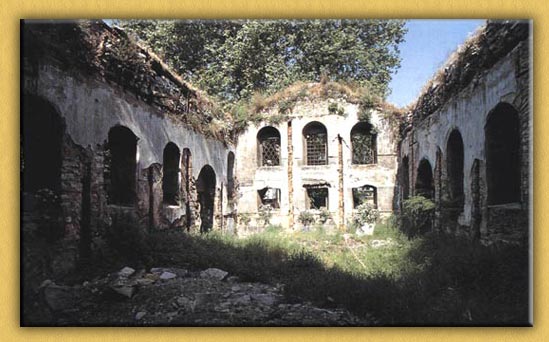
    Church of the Virgin Paramythia - 'Vlach Saray'

    The «most beautiful ruins» in the City, if one takes the liberty in speaking of ruins to call them beautiful.
    The entire district that includes the church, close by the Metochi of the Holy Sepulchre in the Phanar, was once owned by the rulers of Wallachia. Their palaces, the "Saraya of Vlachia ", stood in the same quarter and so the church became widely known as Vlach Saray. The Constantinopolitan Ghikas, Soutsos and Cantacouzinos families used to attend this church, among them omnipotent individuals like Michail Cantacouzinos 'Seitanoglou' (Son of the Devil). The latter was a close friend of the Grand Vizier Sokoli (1560-1575) and holder of the salt monopoly. Cantacouzinos was destined one day, when his fortunes were in decline, to be hanged on the order of Mural IΙΙ from the great gate of the palace he owned at Anchialo.
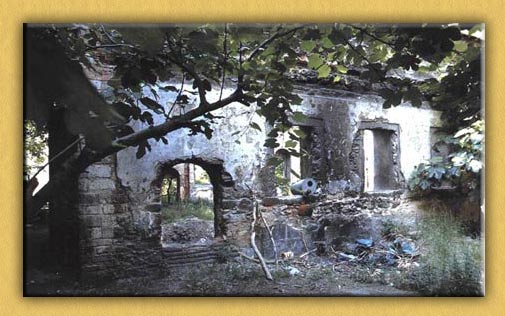
    The church has a long and tragic history, undergoing frequent destruction and restoration. It was burnt down in 1640 and again in 1729. Rebuilt in 1730 it was saved, as if by a miracle, from another conflagration at the end of the 18th century. It was again rebuilt in the mid 19th century only to be wholly destroyed by fire in 1970.
    The visitor who manages to penetrate the ruined area, now that the level approach from the rear is no longer feasible because the neighbourhood grocer has turned it into a storage space for his wooden crates, will feel his heart miss a beat as he reflects that for a decade at the end of the 16th century the Patriarchate was established here and the local Synod of 1595 met in this place.
    Leaving the site for the Golden Horn, the thought crosses the mind that it would be a blessing indeed if this venerable ruin were restored from its very foundations.

    Ismini Kapandai


    Churches in Constantinople


    Nikos Ghinis – Constantinos Stratos


    [/glow]
    [/frame]

    †††التوقيع†††


    اترك لكم كلماتي
    وآخذ معي ذكرياتي معكم ، ومحبة الإخوة .
    والرب يرمم ماسقط مني سهواً أو عن ضعف .
    فما اردت يوماً ان اكون
    سوى ماكنتهُ وكما انا
    خادماً لأحباء يسوع
    وغاسل ارجل .

    -------------------


  7. #7
    آباء الكنيسة الأرثوذكسية
    التسجيل: Jan 2008
    العضوية: 8488
    الإقامة: Lebanon
    الجنس: male
    العقيدة: الكنيسة الأرثوذكسية / روم أرثوذكس
    أُفضل في الموقع: غير ذلك
    الحالة: Fr. Boutros Elzein غير متواجد حالياً
    المشاركات: 1,962

    Array

    Mentioned
    0 Post(s)
    Tagged
    0 Thread(s)

    افتراضي رد: Archdiocese of Constantinople

    [frame="13 98"]
    [glow=00FFFF]
    [glow=CCFF00]


    Church of the Dormition of the Mother of God Valinou

    Following the sea-walls along the shore of the Golden Horn, before reaching the Church of Saint Demetrios Xyloportas one arrives at the Church of the Mother of God Valinou.
    Built and rebuilt like many others after the great fires which devastated the district, it is in an abject condition today. Externally the building is in urgent need of conservation, while the interior is slowly but steadily being destroyed by damp.
    The attribute Balinou takes one back lo Magister Pavlinos who held office under Theodosios fl. nicknamed 'the Small' (409-450).
    The church, whose finances were in a pitiful state, was on the point of being sold when Meletios Pigas, Patriarch of Alexandria, rescued it by settling its debts in 1597. Later it came under the protection of the rulers of Wallachia. Nonetheless, its economic well-being, though at one time it did take a turn for the better, can never have been on a sound footing, for Gedeon notes that "the church treasury gave meagre sums to works of public benefit".
    There is no mention το be found of a school, he continues, and attributes this to the likelihood of the children of the parish attending classes at the adjacent school of Saint Demetrios at Xyloporta.
    Ismini Kapandai
    Churches in Constantinople
    Nikos Ghinis – Constantinos Stratos
    [/glow]
    [/glow]
    [/frame]

    †††التوقيع†††


    اترك لكم كلماتي
    وآخذ معي ذكرياتي معكم ، ومحبة الإخوة .
    والرب يرمم ماسقط مني سهواً أو عن ضعف .
    فما اردت يوماً ان اكون
    سوى ماكنتهُ وكما انا
    خادماً لأحباء يسوع
    وغاسل ارجل .

    -------------------


  8. #8
    آباء الكنيسة الأرثوذكسية
    التسجيل: Jan 2008
    العضوية: 8488
    الإقامة: Lebanon
    الجنس: male
    العقيدة: الكنيسة الأرثوذكسية / روم أرثوذكس
    أُفضل في الموقع: غير ذلك
    الحالة: Fr. Boutros Elzein غير متواجد حالياً
    المشاركات: 1,962

    Array

    Mentioned
    0 Post(s)
    Tagged
    0 Thread(s)

    افتراضي رد: Archdiocese of Constantinople

    [frame="10 90"]


    Church of Saint Demetrios Xyloportas

    The Church of Saint Demetrios Xyloportas, "known as 'tou Kanavi'," writes A.G. Paspatis, "was an ancient church with a dome, its interior decorated with mosaics. This church was destroyed and the present timber-roofed building was erected in the early years of the 18th century".
    Notwithstanding, no other source mentions a Byzantine church -"it is never mentioned in Byzantine writings"- and the only connection which can be made is through the attribute 'Kanavis', linking it with the patrician Nikolaos Kanavos who was living at the time of the first conquest (1204).
    Renovated successively in 1730, 1835, 1933 and I960, as evidenced by inscribed tablets on the walls, it was restored most recently in 1995, at the expense of G. Vassilopoulos.
    The church is of considerable historical importance as it accommodated the Patriarchate for three years. For a period of about one hundred and forty years after the Fall of the City in 1453 the Patriarchate had no fixed abode. Once Aghia Sophia had been converted into a Muslim shrine the scat of the Great Church of Christ was for a while at the Church of the Holy Apostles, but it was later required to abandon that noble Byzantine church and to be received at the Church of the Virgin Pammakaristos. About a century afterwards it moved from there to the district of the Golden Horn. It left the Church of Saint Demetrios Xyloportas for the Virgin Paramythia to end up eventually, in 1601 or 1602, at the Monastery of Saint George (in the Phanar district) where it has remained ever since.

    Ismini Kapandai

    Churches in Constantinople

    Nikos Ghinis – Constantinos Stratos


    [/frame]

    †††التوقيع†††


    اترك لكم كلماتي
    وآخذ معي ذكرياتي معكم ، ومحبة الإخوة .
    والرب يرمم ماسقط مني سهواً أو عن ضعف .
    فما اردت يوماً ان اكون
    سوى ماكنتهُ وكما انا
    خادماً لأحباء يسوع
    وغاسل ارجل .

    -------------------


  9. #9
    آباء الكنيسة الأرثوذكسية
    التسجيل: Jan 2008
    العضوية: 8488
    الإقامة: Lebanon
    الجنس: male
    العقيدة: الكنيسة الأرثوذكسية / روم أرثوذكس
    أُفضل في الموقع: غير ذلك
    الحالة: Fr. Boutros Elzein غير متواجد حالياً
    المشاركات: 1,962

    Array

    Mentioned
    0 Post(s)
    Tagged
    0 Thread(s)

    افتراضي رد: Archdiocese of Constantinople

    [frame="5 85"]


    Church of the Virgin of Souda Egri Kapou


    The Church of the Virgin of Souda Egrikapou, a timber-roofed basilica built on the same site where once the 13th-century Byzantine Church of Saint Nikitas had stood, close to the Palaces of Blachernæ and the Egri Kapou Gate, was renovated in 1999 by Ioannis Andropoulos. However, the wooden building and the entrance to the complex on one side of the church had already been totally destroyed by fire.
    We know that the church was set fire to in 1640 and again in 1728. An official Ottoman †††††††† refers to the latter event and permits repairs to be made on the grounds that "since the conquest this church has remained in the possession of the Orthodox Greeks ".
    There used to be a Greek school and a medical centre and asylum within the enclosure of the Church of the Virgin of Souda.
    Beneath the altar of the church is an Aghiasma, approached down fourteen stone steps. It is a space with a vaulted roof and marble floor and contains a marble reservoir. According to Gedeon it is a remnant of a Byzantine ablutionary.
    The asylum in the church complex, described in an inscription as
    serving indeed as a free hospital
    a new Siloam for all who attend it,
    was resorted to by the unfortunate insane, but ceased its mission in February 1839.
    Ismini Kapandai
    Churches in Constantinople
    Nikos Ghinis – Constantinos Stratos


    [/frame]

    †††التوقيع†††


    اترك لكم كلماتي
    وآخذ معي ذكرياتي معكم ، ومحبة الإخوة .
    والرب يرمم ماسقط مني سهواً أو عن ضعف .
    فما اردت يوماً ان اكون
    سوى ماكنتهُ وكما انا
    خادماً لأحباء يسوع
    وغاسل ارجل .

    -------------------


  10. #10
    آباء الكنيسة الأرثوذكسية
    التسجيل: Jan 2008
    العضوية: 8488
    الإقامة: Lebanon
    الجنس: male
    العقيدة: الكنيسة الأرثوذكسية / روم أرثوذكس
    أُفضل في الموقع: غير ذلك
    الحالة: Fr. Boutros Elzein غير متواجد حالياً
    المشاركات: 1,962

    Array

    Mentioned
    0 Post(s)
    Tagged
    0 Thread(s)

    افتراضي رد: Archdiocese of Constantinople

    [frame="4 85"]


    Church of Saint George Antiphonitis in the Phanar

    Of impressive size, this three-aisled, stone-built and timber-roofed basilica is a handsome building of 1830. It has a very fine narthex and an iron bell tower. The Church of Saint George Potiras, recently restored by two brothers, Christos and Ninos Elmacioglou (1998), once belonged to the family of "the Logothetis (Chief Secretary) of the Great Church, Georgios Potiras".
    The church stands at the far end of a delightful garden with shady trees. The courtyard is protected by an enclosure wall of particularly line workmanship.
    Gedeon confirms there is no earlier mention of the church than one dating to 1648. Nevertheless, it is possible it served briefly as a patriarchal dwelling when the Patriarchate was evicted from the Pammakaristos.
    The attribute 'Antiphonitis', which should be 'Christ Antiphonitis', arises from a delightful legend. In bygone times, it is said, there was a usurer who insisted that another Christian owed him money. The poor man attempted in vain to prove it was not so. In the end, despairing, he made a proposal: "Let's go to the icon of Christ. If your conscience allows you to, repeat those lies there ". The usurer went along with him, and when the icon heard him it contradicted him ('antiphonise') and the poor man was vindicated.
    There are some fine marble reliefs and some inscriptions. An enormous earthenware jar is embedded in the right-hand wall of the narthex to receive offerings of olive oil. Next to it is an inscription with an exhortation:
    Christian, whenever you bring an offering lo the altar
    Your pious hand should pour the olive oil herein
    In Photira 1.12.1883

    Ismini Kapandai


    Churches in Constantinople


    Nikos Ghinis – Constantinos Stratos


    [/frame]

    †††التوقيع†††


    اترك لكم كلماتي
    وآخذ معي ذكرياتي معكم ، ومحبة الإخوة .
    والرب يرمم ماسقط مني سهواً أو عن ضعف .
    فما اردت يوماً ان اكون
    سوى ماكنتهُ وكما انا
    خادماً لأحباء يسوع
    وغاسل ارجل .

    -------------------


صفحة 1 من 2 12 الأخيرةالأخيرة

المفضلات

المفضلات

ضوابط المشاركة

  • لا تستطيع إضافة مواضيع جديدة
  • لا تستطيع الرد على المواضيع
  • لا تستطيع إرفاق ملفات
  • لا تستطيع تعديل مشاركاتك
  •