Warning: preg_replace(): The /e modifier is deprecated, use preg_replace_callback instead in ..../includes/class_bbcode.php on line 2962

Warning: preg_replace(): The /e modifier is deprecated, use preg_replace_callback instead in ..../includes/class_bbcode.php on line 2958

Warning: preg_replace(): The /e modifier is deprecated, use preg_replace_callback instead in ..../includes/class_bbcode.php on line 2958

Warning: preg_replace(): The /e modifier is deprecated, use preg_replace_callback instead in ..../includes/class_bbcode.php on line 2962
Eastern Orthodox Statues

الأعضاء الذين تم إشعارهم

النتائج 1 إلى 6 من 6

الموضوع: Eastern Orthodox Statues

  1. #1
    أخ/ت مجتهد/ة الصورة الرمزية سليمان
    التسجيل: Mar 2007
    العضوية: 843
    الجنس: male
    العقيدة: الكنيسة الأرثوذكسية / روم أرثوذكس
    الحالة: سليمان غير متواجد حالياً
    المشاركات: 985

    Array

    Mentioned
    0 Post(s)
    Tagged
    0 Thread(s)

    New21212 Eastern Orthodox Statues

    [gdwl][glint]Ask, and it will be given you. Seek, and you will find.[/glint] Knock, and it will be opened for you[/gdwl]
    Matthew 7:7


    Eastern Orthodox Statues
    by Fr. Les Bundy

    Part I


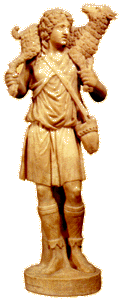
    An ancient Good Shepherd statue found in the Roman catacombs


    The innumerable beautiful ancient icons that have flooded the west since the first World War, and the increasing interest in them by artists, scholars and ordinary lovers of the beautiful has been one of the bright phenomena of the past two generations. An enormous literature has developed around the icon, both scholarly and popular, and centers for the reproduction of old icons, and the painting of new ones has become especially widespread since the Second World War

    For a great many people the Icon is the supreme symbol of the Orthodox Church. This has been especially true on the popular level since the western world was flooded by Russian émigrés and religious artifacts following World War I. Shortly thereafter the revival in Byzantine studies gained impetus and icons were studied on a serious level while the antique shops offered examples of everything from rare ancient specimens to the great liquid-eyed 19th century romantic western imitations that in the eighteenth century had supplanted the traditional types in the Orthodox lands


    [gdwl] [/gdwl][gdwl][/gdwl][gdwl][/gdwl][gdwl][/gdwl]
    [gdwl]

    For many westerners, and in the Orthodox folklore, icons are the Eastern substitute for statues commonly, and erroneously, believed to the forbidden in the Orthodox Church. Actually, statues are by no means forbidden in Orthodoxy and were always a regular part of the decorative and devotional furnishing of the sacred space, the church interior

    Icon, now commonly used as a technical term for the flat, perspective less devotional pictures of oriental Orthodoxy is simply the Greek word for “image.” The Ecumenical Counciliar dogmatic decrees on icons refer, in fact, to all religious images including three-
    dimensional statues
    Professor Sergios Verkhovskoi, the conservative professor of dogmatics at St. Vladimir’s Seminary forthrightly condemns as heretical anyone who declares statues as unOrthodox or in any way canonically inferior to paintings

    By the 19th Century the traditional flat paintings, derived from Hellenistic Egyptian funerary portraits, and currently claimed to be “authentic” icons had been supplanted throughout the Orthodox Church by western naturalistic painting, more or less skilled
    [/gdwl]
    How, then, did the common opinion arise that statues were “western,” “heterodox,” “heretical”? [gdwl] [/gdwl][gdwl][/gdwl][gdwl][/gdwl][gdwl][/gdwl]
    [gdwl]

    The answer is quite simple and derived from sound cultural and sociological foundations
    [/gdwl]
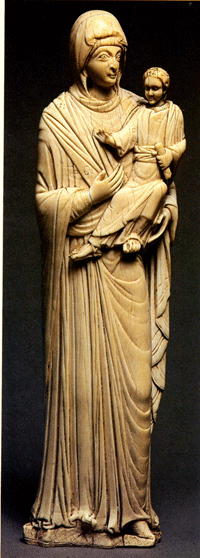
    Statues were common in Byzantium. Our title picture illustrates an ivory, three-dimensional statuette, of the Virgin and Child, “Hodegetria,” from 10th Century Constantinople. Now in the Victoria and Albert museum, it differs from similar examples in Hamburg and New York, in that it was not cut out of an ivory tablet. The back is as carefully and skillfully carved as the front


    The ivory Hodegetria statue from Victoria and Albert Museum, London
    القرن العاشر

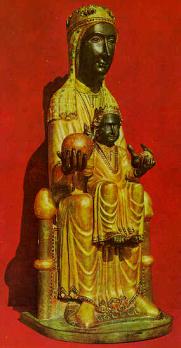
    Constantinople was filled with statues, both within and outside of the churches. One author claims that over three hundred classical statues adorned the plaza before Sancta Sophia. The famous Spanish Madonna, Our Lady of Montserrat, is a Byzantine statue as are many ancient examples in southern France, but it was in Russia that Orthodox Christian freedom in the use of images survived

    Let us consider the reasons why
    statues became unpopular in Orthodoxy


    Our Lady of Montserrat statue

    The main cause, of course, is Iconoclasm (image breaking). As early as the art in the Roman catacombs Christians used sacred images, both for instruction and, evidently, as a means of venerating the person or event depicted. Most of these are paintings, but at least two statues of the Good Shepherd are anterior to Constantine and the Veneration of the Cross is so ancient no initial date can be fixed for it. By 576 we have evidence, in the west, that an image of St. Martin was honored by a lamp constantly burning before it and that Fortunatus had been cured of an ailment by oil taken from it

    By the beginning of the 8th Century the Jews, basing their stand on the Old Testament proscription of images, the Paulician heretics (a branch of the Manicheans, a sect that despised “matter’ as inferior to “spirit.”), and the Monophysites all opposed images. These latter were heretics who declared that Jesus was God and hence His human nature was swallowed up by His divinity and so his unimportant humanity should not be depicted. Furthermore in some areas: Syria, Egypt and among the Germanic tribes, there was a basic distrust of the Greek esteem for human beauty, especially as manifested in art

    All of these influences seem to have proven congenial to the Emperor Leo the Isaurian who in 726 issued his first edict for the destruction of images. There was popular opposition, the Roman bishops protested, and St. John of Damascus summarized the testimony of the Fathers in the three famous essays. Leo died in 740 and was succeeded by his son Constantine V, Copronymus, who pursued his father’s program with barbaric vigor. When he died in 780 his wife, Irene, began the work of restoration and seven years later convoked the Seventh Ecumenical Council in Nicaea which fully restored the veneration of images. After a subsequent period of persecution (the Iconoclastic movement survived in some strength from 726 to 842) the restoration of images was fixed in 842

    The anti-image influence in Constantinople came from Syrians and Armenians, tinctured by Monophysitism, in the west it came from the Emperor Charlemagne and persisted in the Frankish lands until the ninth century, although Rome and Italy adopted the Orthodox position from the first. It is evident from this survey that racial-
    cultural heritages were highly influential


    To Be Continued

    †††التوقيع†††

    †††
    It is truly right to bless you
    O Theotokos

    دير القديس سمعان بطرس
    مركز "العذراء أم الرحمة"

  2. #2
    أخ/ت مجتهد/ة الصورة الرمزية سليمان
    التسجيل: Mar 2007
    العضوية: 843
    الجنس: male
    العقيدة: الكنيسة الأرثوذكسية / روم أرثوذكس
    الحالة: سليمان غير متواجد حالياً
    المشاركات: 985

    Array

    Mentioned
    0 Post(s)
    Tagged
    0 Thread(s)

    افتراضي رد: Eastern Orthodox Statues

    Eastern Orthodox Statues
    by Fr. Les Bundy

    Part II


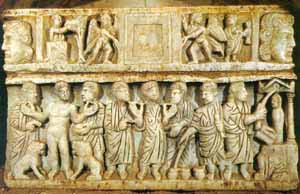
    Sarcophagus of the Bambino, Roman catacombs

    The same may be said of the practical disappearance of statues as opposed to icons over large areas of the Orthodox Church. The lingering memory of the Iconoclasts encouraged reticence and the Moslem conquest froze Orthodox art in its most limited form. In the conquered areas the Church was driven indoors, bells were proscribed, and the externals of Christian worship were forbidden in public. While all representations of creatures were banned for Moslem, and pressure put on Christians to conform as much as possible the icon survived while the statue could not. Only in Russia was the Church free enough to maintain its full aesthetic devotional tradition

    Northern Russian woodcarving was highly developed before the coming of the Orthodox missionaries and it survived and was “baptized” into the service of the Church. All images, statues and icons, were carefully watched by ecclesiastical authority as in a ukase of the Holy Synod on March 15, 1722. From the Revolution of 1918 until after World War II statues of historical value suffered the destruction directed at all religious monuments, but currently concern for the achievements of the Russian past has focused money, attention and research on all ancient art and Orthodox statues are especially valued

    Hundreds of examples of these devotional objects were destroyed in the first phase of the Revolutionary anti-religious campaign. Yet many statues and three-dimensional crucifixes are plentiful and still in use

    The 1920’s discovered the Orthodox painted icon, the 1970’ the Orthodox statues

    It appears the sometimes heated "two dimensional vs. three dimensional image" argument could be another example of culture intruding upon the faith

    O Lord Jesus Christ, Son of the Living God, have mercy upon me, for I am a sinner

    In Christ I remain His servant

    †††التوقيع†††

    †††
    It is truly right to bless you
    O Theotokos

    دير القديس سمعان بطرس
    مركز "العذراء أم الرحمة"

  3. #3
    أخ/ت مجتهد/ة الصورة الرمزية سليمان
    التسجيل: Mar 2007
    العضوية: 843
    الجنس: male
    العقيدة: الكنيسة الأرثوذكسية / روم أرثوذكس
    الحالة: سليمان غير متواجد حالياً
    المشاركات: 985

    Array

    Mentioned
    0 Post(s)
    Tagged
    0 Thread(s)

    افتراضي رد: Eastern Orthodox Statues

    [glint]
    [gdwl]Ask, and it will be given you. Seek, and you will find. Knock, and it will be opened for you[/gdwl]
    [/glint]

    Matthew 7:7

  4. #4
    أخ/ت مجتهد/ة الصورة الرمزية سليمان
    التسجيل: Mar 2007
    العضوية: 843
    الجنس: male
    العقيدة: الكنيسة الأرثوذكسية / روم أرثوذكس
    الحالة: سليمان غير متواجد حالياً
    المشاركات: 985

    Array

    Mentioned
    0 Post(s)
    Tagged
    0 Thread(s)

    افتراضي رد: Eastern Orthodox Statues

    Icon Not-Made-By-Hands
    One of the earliest Icons witnessed to by Church Tradition, is the Icon of the Savior Not-Made-By-Hands. According to Tradition, during the time of the earthly ministry of the Savior, Abgar ruled in the Syrian city of Edessa. He was afflicted with leprosy over his whole body. At this time report of the great miracles performed by the Lord extended throughout Syria (Matt. 4:24) and as far as Arabia. Although not having seen the Lord, Abgar believed in Him as the Son of God and wrote a letter requesting Him to come and heal him. With this letter he sent to Palestine his court-painter Ananias, entrusting him to paint an image of the Divine Teacher

    Ananias went to Jerusalem and saw the Lord surrounded by people. He was not able logo to Him because of the great throng of people listening to His preaching; so he stood on a huge rock and attempted to produce a painting of the image of the Lord Jesus Christ, unable, however, to succeed. The Savior Himself called him by name and gave for Abgar a beautiful letter in which,' having glorified the faith of the ruler, He promised to send His disciple in order to heal him from the leprosy and instruct him in salvation

    After this, the Lord called for water and a towel. He wiped His face, rubbing with the towel, and on it was impressed His Divine Image. The towel and the letter the Savior sent with Ananias to Edessa. With thanksgiving Abgar received the sacred object and received healing, but a small portion, only a trace, remained of the terrible disease on his face until the arrival of the promised Disciple of the Lord

    The Apostle of the 70, Thaddeus, came to them and preached the Gospel, baptizing the believing Abgar and all living in Edessa. Having written on the Image Not-Made-By-Hands the words, Christ-God, everyone trusting in Thee will not be put to shame, Abgar adorned it and placed it in a niche over the city gates

    For many years the inhabitants preserved a pious custom of venerating the Image Not-Made-By-Hands whenever passing through the gates. But a great-grandson of Abgar, ruling Edessa, fell into idolatry and resolved to take the Image away from the city walls. In a vision, the Lord ordered the Bishop of Edessa to conceal His Image. The Bishop, coming at night with his clergy, lit before the Image a lampada and then blocked up the niche with clay tablets and bricks

    Many years passed by and the inhabitants forgot about the Holy Object. But then, when in 545 the Persian King Chroses I besieged Edessa, the position of the city seemed hopeless. But the Most-Holy Sovereign Lady manifested Herself to Bishop Evlavios and commanded him to get from the enclosed niche the Image with which to save the city from the adversaries. Dismantling the niche, the Bishop found the Holy Image; before it burned the lampada and on the clay tablets, with which the niche had been enclosed, was a similar image. After preceding with the Cross and the Image Not-Made-By-Hands around the walls of the city, the Persian army miraculously departed

    In 630, Edessa was seized by the Arabs; but they did not impede veneration of the Image Not-Made-By-Hands, glory of which extended out into all the East. In 944 the Emperor Constantine Porphyrogenitus (912-59) requested that the Image be redeemed from the Emir the ruler of the city of Edessa and brought to the Capital of the Orthodox. With great honor the Image of the Savior Not-Made-By-Hands and the letter which He wrote to Abgar, were brought by the clergy to Constantinople. On Aug. 16 the Image of the Savior was placed in the Pharos Church of the Most-Holy Theotokos.
    Concerning the subsequent fate of the Image Not-Made-By-Hands, there exists several traditions. According to one, it was carried away by Crusaders during the time of their dominion over Constantinople (1204-61), but the ship on which the Holy Objects had been taken, sank in the Sea of Marmora. According to another, the Image Not-Made-By-Hands was taken about 1362 to Genoa, where it was presented to and preserved in a monastery dedicated to the Apostle Bartholomew

    In the time of the iconoclastic heresy, the defenders of icon-veneration, shedding their blood for the Holy Icons, sang the Troparion to the Image Not-Made-By-Hands. The Image (the Holy Face) was put up as an emblem of the Russian armies, defending them from the enemy; and in the Russian Orthodox Church there is a pious custom that before entering a church, the faithful read together the prayers and the Troparion to the Image Not-Made-By-Hands. The Feast of this Icon is celebrated on Aug. 16, during the Afterfeast period of the Feast of the Dormition, and is popularly called the Third Feast-of-the-Savior in August
    Excerpt taken from "These Truths We Hold - The Holy Orthodox Church: Her Life and Teachings". Compiled and Edited by A Monk of St. Tikhon's Monastery. Copyright 1986 by the St. Tikhon's Seminary Press, South Canaan, Pennsylvania 18459

    To order a copy of "These Truths We Hold" visit the
    St. Tikhon's Orthodox Seminary Bookstore

    †††التوقيع†††

    †††
    It is truly right to bless you
    O Theotokos

    دير القديس سمعان بطرس
    مركز "العذراء أم الرحمة"

  5. #5
    أخ/ت مجتهد/ة الصورة الرمزية سليمان
    التسجيل: Mar 2007
    العضوية: 843
    الجنس: male
    العقيدة: الكنيسة الأرثوذكسية / روم أرثوذكس
    الحالة: سليمان غير متواجد حالياً
    المشاركات: 985

    Array

    Mentioned
    0 Post(s)
    Tagged
    0 Thread(s)

    افتراضي رد: Eastern Orthodox Statues

    Holy Icons

    One of the first things that strikes a non-Orthodox visitor to an Orthodox church is the prominent place assigned to the Holy Icons. The Iconostasis (Icon-screen) dividing the Altar from the rest of the church is covered with them, while others are placed in prominent places throughout the church building. Sometimes even the walls and ceiling are covered with them in fresco or mosaic form. The Orthodox faithful prostrate themselves before them, kiss them, and burn candles before them. They are censed by the Priest and carried in processions. Considering the obvious importance of the Holy Icons, then, questions may certainly be raised concerning them: What do these gestures and actions mean? What is the significance of these Icons? Are they not idols or the like, prohibited by the Old Testament


    Some of the answers to these questions can be found in the writings of St. John of Damascus (f776), who wrote in the Mid-Eighth Century at the height of the iconoclast (anti-icon) controversies in the Church, controversies which were resolved only by the 7th Ecumenical Council (787), which borrowed heavily from these writings


    As St. John points out, in ancient times God, being incorporeal and uncircumscribed, was never depicted, since it is impossible to represent that which is immaterial, has no shape, is indescribable and is unencompassable. Holy Scripture states categorically: No one has ever seen God (John 1:18) and You cannot see My [God's] face, for man shall not see Me and live (Ex. 33:20). The Lord forbade the Hebrews to fashion any likeness of the Godhead, saying: I7ou shall not make for yourself a graven image, or any likeness of anything that is in heaven above, or that is in the earth beneath, or that is in the water under the earth (Ex. 20:4). Consequently, the Holy Apostle Paul also asserts: Being then God's offspring, we ought not to think that the Deity is like gold, or silver, or stone, a representation by the art and imagination of man (Acts 17:29)
    Nonetheless, we know that Icons have been used for prayer from the first centuries of Christianity. Church Tradition tells us, for example, of the existence of an Icon of the Savior during His lifetime (the Icon-Made-Without-Hands) and of Icons of the Most-Holy Theotokos immediately after Him. Tradition witnesses that the Orthodox Church had a clear understanding of the importance of Icons right from the beginning; and this understanding never changed, for it is derived from the teachings concerning the Incarnation of the Second Person of the Holy Trinity Our Lord and Savior Jesus Christ. The use of Icons is grounded in the very essence of Christianity, since Christianity is the revelation by the God-Man not only of the Word of God, but also of the Image of God; for, as St. John the Evangelist tells us, the Word became
    flesh and dwelt among us- John 1:14


    No one has ever seen God; the only Son, Who is in the bosom of the Father, He has made Him known (John 1:18), the Evangelist proclaims. That is, He has revealed the Image or Icon of God. For being the brightness of [God's] glory, and the express image of [God's] person (Heb. 1:3), the Word of God in the Incarnation revealed to the world, in His own Divinity, the Image of the Father. When St. Philip asks Jesus, Lord, show us the Father, He answered him: Have I been with you so long, and yet you do not know Me, Philip? He who has seen Me has seen the Father (John 14:8, 9). Thus as the Son is in the bosom of the Father, likewise after the Incarnation He is consubstantial with the Father, according to His divinity being the Father's Image, equal in honor to Him


    The truth expressed above, which is revealed in Christianity, thus forms the foundations of Christian pictorial art. The Image (or Icon) not only does not contradict the essence of Christianity, but is unfailingly connected with it; and this is the foundation of the tradition that from the very beginning the Good News was brought to the world by the Church both in word and in image. This truth was so self-evident, that Icons found their natural place in the Church, despite the Old Testament prohibition against them and a certain amount of contemporary opposition


    St. John Damascene further tells us that because the Word became flesh (John 1:14), we are no longer in our infancy; we have grown up, we have been given by God the power of discrimination and we know what can be depicted and what is indescribable. Since He Who was incorporeal, without form, quantity and magnitude, Who was incomparable owing to the superiority of His nature, Who existed in the image of God assumed the form of a servant and appeared to us in the flesh, we can portray Him and reproduce for contemplation Him Who has condescended to be seen


    We can portray His ineffable descent, His Nativity from the Blessed Virgin, His Baptism in the Jordan, His Transfiguration on Mt. Tabor, His sufferings, death and miracles. We can depict the Cross of Salvation, the Sepulcher, the Resurrection and the Ascension, both in words and in colors. We can confidently represent God the Invisible not as an invisible being, but as one Who has made Himself visible for our sake by sharing in our flesh and blood


    As the Holy Apostle Paul says: Ever since the creation of the world [God's] invisible nature, namely, His eternal power and deity, has been clearly perceived in the things that have been made (Rom. 1:20). Thus, in all creatures we see images that give us a dim insight into Divine Revelation when, for instance, we say that the Holy Trinity Without Beginning can be represented by the sun, light and the ray, or by the mind, the word and the spirit that is within us, or by the plant, the flower and the scent of the rose


    [gdwl]Thus, what had only been a shadow in the Old Testament is now clearly seen. The Council in Trullo (691-2), in its 82nd Rule, stated[/gdwl]


    [glint]Certain holy icons have the image of a lamb, at which is pointing the finger of the Forerunner. This lamb is taken as the image of grace, representing the True Lamb, Christ our God, Whom the law foreshadowed. Thus accepting with love the ancient images and shadows as prefigurations and symbols of truth transmitted to the Church, we prefer grace and truth, receiving it as the fulfillment of the law. Thus, in order to make plain this fulfillment for all eyes to see, if only by means of pictures, we ordain that from henceforth icons should represent, instead of the lamb of old, the human image of the Lamb, Who has taken upon Himself the sins of the world, Christ our God, so that through this we may perceive the height of the abasement of God the Word and be led to remember His life in the flesh, His Passion and death for our salvation and the ensuing redemption of the world[/glint]
    The Orthodox Church, then, created a new art, new in form and contents, which uses images and forms drawn from the material world to transmit the revelation of the divine world, making the divine accessible to human understanding and contemplation. This art developed side by side with the Divine Services and, like the Services, expresses the teaching of the Church in conformity with the word of Holy Scripture. Following the teachings of the 7th Ecumenical Council, the Icon is seen not as simple art, but that there is a complete correspondence of the Icon to Holy Scripture, for if the [Icon] is shown by [Holy Scripture], [Holy Scripture] is made incontestably clear by the [Icon] [Acts of the 7th Ecumenical Council, 6]
    As the word of Holy Scripture is an image, so the image is also a word, for, according to St. Basil the Great (f379), what the word transmits through the ear, that painting silently shows through the image [Discourse 19, On the 40 Martyrs]. In other words, the Icon contains and professes the same truth as the Gospels and therefore, like the Gospels, is based on exact data, and is not a human invention, for if it were otherwise, Icons could not explain the Gospels nor correspond to them

    By depicting the divine, we are not making ourselves similar to idolaters; for it is not the material symbol that we are worshipping, but the Creator, Who became corporeal for our sake and assumed our body in order that through it He might save mankind. We also venerate the material objects through which our salvation is effected the blessed wood of the Cross, the Holy Gospel, and, above all, the Most-Pure Body and Precious Blood of Christ, which have grace-bestowing properties and Divine Power.
    As St. John Damascene asserts: I do not worship matter but I worship the Creator of matter, Who for my sake became material and deigned to dwell in matter, Who through matter effected my salvation. I will not cease from worshipping the matter through which my salvation has been effected [On Icons, 1,16]. Following his teachings, we, as Orthodox Christians, do not venerate an Icon of Christ because of the nature of the wood or the paint, but rather we venerate the inanimate image of Christ with the intention of worshipping Christ Himself as God Incarnate through it

    We kiss an Icon of the Blessed Virgin as the Mother of the Son of God, just as we kiss the Icons of the Saints as God's friends who fought against sin, imitated Christ by shedding their blood for Him and followed in His footsteps. Saints are venerated as those who were glorified by God and who became, with God's help, terrible to the Enemy, and benefactors to those advancing in the faith but not as gods and benefactors themselves; rather they were the slaves and servants of God who were given boldness of spirit in return for their love of Him. We gaze on the depiction of their exploits and sufferings so as to sanctify ourselves through them and to spur ourselves on to zealous emulation

    The Icons of the Saints act as a meeting point between the living members of the Church [Militant] on earth and the Saints who have passed on to the Church [Triumphant] in Heaven. The Saints depicted on the Icons are not remote, legendary figures from the past, but contemporary, personal friends. As meeting points between Heaven and earth, the Icons of Christ, His Mother, the Angels and Saints constantly remind the faithful of the invisible presence of the whole company of Heaven; they visibly express the idea of Heaven on earth

    In venerating the Icons, then, the Orthodox are championing the basis of Christian faith the Incarnation of God and, consequently, salvation and the very meaning of the Church's existence on earth, since the creation of the Holy Icons goes back to the very origins of Christianity and is an inalienable part of the truth revealed by God, founded as it is on the person of the God-Man Jesus Christ Himself. Holy Images are part of the nature of Christianity and without the Icon Christianity would cease to be Christianity. The Holy Gospel summons us to live in Christ, but it is the Icon that shows us this life.
    If God became man in order that man might be like God, the Icon, in full accord with divine worship and theology, bears witness to the fruits of the Incarnation and to the sanctity and deification of man. It shows him in the fullness of his earthly nature, purified of sin and partaking of the life of God, testifies to the sanctification of the human body and displays to the world the image of man who is similar to God by grace. The Icon outwardly expresses the sanctity of the depicted Saint, and this sanctity is apparent to bodily vision

    Thus, according to St. John Damascene, those who refuse to venerate an Icon also refuse to worship God's Son, Who is the living image and unchanging reflection of God the Invisible. Be it known, he says, that anyone who seeks to destroy the Icons of Christ or His Mother, the Blessed Theotokos, or any of the Saints, is the enemy of Christ, the Holy Mother of God, and the Saints, and is the defender of the Devil and his demons


    Excerpt taken from "These Truths We Hold - The Holy Orthodox Church: Her Life and Teachings". Compiled and Edited by A Monk of St. Tikhon's Monastery. Copyright 1986 by the St. Tikhon's Seminary Press, South Canaan, Pennsylvania 18459

    To order a copy of "These Truths We Hold" visit the
    St. Tikhon's Orthodox Seminary Bookstore

    †††التوقيع†††

    †††
    It is truly right to bless you
    O Theotokos

    دير القديس سمعان بطرس
    مركز "العذراء أم الرحمة"

  6. #6
    أخ/ت نشيط/ة الصورة الرمزية Dimah
    التسجيل: Oct 2007
    العضوية: 1220
    الإقامة: سوريا
    هواياتي: المطالعة
    الحالة: Dimah غير متواجد حالياً
    المشاركات: 302

    Array

    Mentioned
    0 Post(s)
    Tagged
    0 Thread(s)

    افتراضي رد: Eastern Orthodox Statues

    [glow=3366FF]


    May God bless you and protect you always


    [/glow][glow=3366FF]


    Remember me in your prayers to the Lord

    [/glow]

    †††التوقيع†††

    †††
    [glow1=FFFF99]
    أيتها الفائق قدسها خلصينا
    ياربي يسوع المسيح ارحمني أنا أمتك الخاطئة
    اقتربت مشيئة الرب والعريس بآتٍ
    فلنضى المصابيح
    [/glow1]

المواضيع المتشابهه

  1. In Search for an Important Orthodox Teaching
    بواسطة سليمان في المنتدى English Discussion Forum
    مشاركات: 1
    آخر مشاركة: 2008-09-29, 10:05 AM
  2. Exorcism in the Orthodox Church
    بواسطة سليمان في المنتدى English Discussion Forum
    مشاركات: 2
    آخر مشاركة: 2008-05-20, 12:41 AM
  3. On Church and Tradition An Eastern Orthodox View
    بواسطة Habib في المنتدى English Discussion Forum
    مشاركات: 29
    آخر مشاركة: 2007-10-22, 09:06 PM
  4. Timeline of Orthodox History
    بواسطة سليمان في المنتدى English Discussion Forum
    مشاركات: 2
    آخر مشاركة: 2007-09-27, 05:11 AM
  5. Orthodox Educational Resources
    بواسطة سليمان في المنتدى English Discussion Forum
    مشاركات: 0
    آخر مشاركة: 2007-09-16, 04:21 AM

المفضلات

المفضلات

ضوابط المشاركة

  • لا تستطيع إضافة مواضيع جديدة
  • لا تستطيع الرد على المواضيع
  • لا تستطيع إرفاق ملفات
  • لا تستطيع تعديل مشاركاتك
  •