
 انضم لنا على فيسبوك
 جديد المنتدى
 تابعنا على تويتر
 تابع أعمالنا على يوتيوب
 تابعنا على جوجل بلاس
 تابعنا على اينستغرام
 تابعنا على بينتريست
 تابعنا على سكريبد
 تابعنا على سلايدشير
 تابعنا على ساوند كلاود
 تابعنا على تامبلر


 رد: Pinpointing Christ's Birth Date
On What Day Was Jesus Christ Born
part 3
-- i --
+ +
+
To ascertain the day when our Lord, God, and Savior Jesus Christ was born, we need to know when St. John the Baptist was conceived, because all the events which follow proceed from that day. Six months afterward, according to Holy Scripture and Orthodox Christian Tradition, the Archangel Gabriel announced the Conception of our Lord to the Holy Theotokos and Blessed Virgin Mary. The birth of St. John the Baptist occurred on June 24, nine months from his conception. The Church assigns the Conception of St. John to September 23 on the calendar, for reasons which shall shortly be made clear. More supportive data are required, however, and for them we must go beyond what is found in the
Holy Bible
In the West the tendency has been to rely solely on Holy Scripture, or else on logic, without reference to Orthodox Christian Tradition. This has led to a number of absurdities inherent in Roman Catholicism and Fundamentalist Protestantism. Gnostic cults, such as the Cathars, Freemasons, Mormons, and Rosicrucians arose in the West in reaction to such perceptions. These cults appeal to people who feel instinctively that the Bible is insufficient by itself, and that there is more to the world than logic alone can explain
Turning to the conception of St. John the Baptist and why it is celebrated on September 23, we need go no farther than what St. Luke reports concerning the vision of St. Zacharias: "The whole multitude of the people were praying without at the time of incense," on a day which climaxed a series of days -- "those days." Incense was frequently offered in the Temple, of course, but there was a day when the whole multitude of Jerusalem would assemble in the Temple or as near the Temple as possible. It was a day considered the holiest in the entire Jewish year, Yom Kippur, the Day of Atonement, when the whole multitude of the Jewish people would be blessed, the one day of the year when the High Priest would utter the Name of God while blessing the people --Hebrews
9:7
At this point, however, there is a problem. St. Zacharias could not possibly have offered incense on Yom Kippur. On that day all the priestly functions were reserved to the High Priest (Ibid.). One must look, then, for a day when the father of St. John may have offered incense, when the whole multitude of the people would have assembled, and a day which would have been the last of a sequence of "those days." Since no priest other than the High Priest was permitted to offer incense more than once in his entire life, the Temple kept careful records of who had offered incense and when. If such records still exist, one would look for the record of a Zacharias of the course of Abia having offered incense on just such a
day in the equivalent of 1 B.C
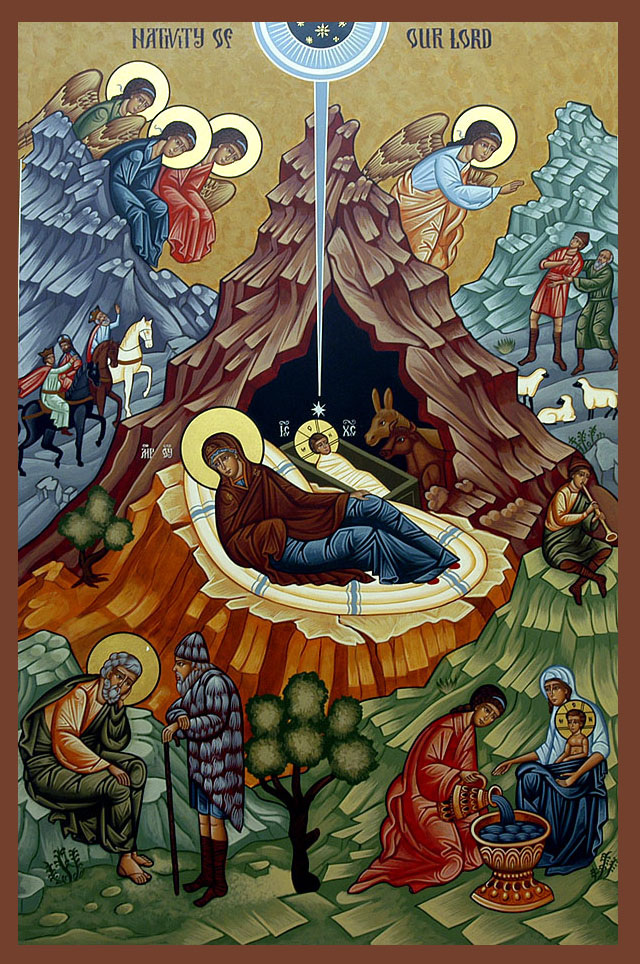
Alfred Edersheim theorized that for theological reasons the Orthodox Church assigned the feast of the Nativity of Christ, commemorating the Birth of Christ the Light of the World, to the first day of the Feast of the Dedication of the Temple (Chanuchah), the Feast of Lights, the 25th of Chislev (usually in December), an eight-day feast instituted by Judas Maccabaeus in 164 B.C., after the war for Jewish independence from Syro-Greek domination had been won (The Temple, p. 293; II Macc. 10:8). This makes sense, given that one of the Orthodox Christian titles of the Mother of God is "Holy Ark of the New Testament," an allusion to the Ark of the Covenant in which were kept the stone tablets inscribed with the Ten Commandments, the Old Testament (Covenant), the Word from Mt. Sinai. This ark used to be kept within the section of the Temple called the Holy of Holies, the section before which St. Zacharias was privileged to offer incense before the Lord. Ethiopian tradition has it that the Ark had been translated to Ethiopia during the reign of King Solomon as a gift to the Queen of Sheba
According to Ethiopian tradition, The Ark of the Covenant presently reposes within the St. Mary of Mt. Sion Cathedral in Auxum, see of the Ethiopian Orthodox Church, so-called. Mt. Sion was the height on which the Temple of Solomon was built as a place of repose for the Ark. Interestingly enough, the original temple of worship at Glastonbury in England, according to Hugh Ross Williamson (following William of Malmsebury), was dedicated to the Theotokos and built by St. Joseph of Arimathea according to the dimensions of the Tabernacle, the tent that once surrounded the Ark and which the Temple of Solomon replaced (The Flowering Hawthorn, p. 27). The Temple, therefore, was a type of the Holy Theotokos. It was thus fitting that Jesus the New Testament was born of
her on the Feast of the Dedication of the Temple
Edersheim's theory is an intriguing one, but it ignores what the Gospel according to St. Luke has to say about the conception of St. John the Forerunner, Prophet, and Baptizer. Is it possible that Chanucha was the occasion, not of Christ's Birth, but of the vision of St. Zacharias? It was, after all, a feast which lasted eight days and which St. Luke therefore could have had in mind as "those days." Chanucha, however, was a minor feast which the whole multitude would not likely have attended, and so that theory must be rejected
Two other possible feasts which lasted for more than just a day were Passover and Sukkot (Tabernacles). Passover must be ruled out as the occasion of St. Zacharias's vision because there is simply no indication of this in the Tradition of the Church, at any time, anywhere, by anyone. In short, to point to Passover would totally conflict with the Vincentian Canon concerning the role to be given to Tradition when interpreting Holy Scripture. Thus only one other possibility remains, Sukkot, the Feast of Tabernacles, which ends on the twenty-second day of the Jewish month of Tishri
Jewish months are all lunar, and so the Jewish calendar, unlike our present civil calendar and unlike the Julian calendar employed by the Romans when Jesus Christ was born, varies from year to year. As with all Jewish feasts, and as with the Orthodox Christian Pascha, Sukkot is a moveable feast, generally occurring in late September and early October
Returning to Alfred Edersheim's research of the Talmud, on its last day, called Shemini Atseret (Solemn Assembly), all the courses [the whole multitude] assembled to participate in the ceremonies. In fact, this was the only feast during the year when all the courses did this --op. cit., p. 66
Tabernacles was a harvest festival celebrated shortly after Yom Kippur to commemorate the time during the Exodus when the Israelites lived in tents after their flight from Egypt. (Lev. 23:36; Nm. 29:35). The last day of Sukkot, Shemini Atseret, was the last day of the last feast of the last month of the Jewish year. What could be more fitting than that this should be the occasion to announce the conception of the last and greatest of the prophets of the Old Testament, St. John the Forerunner, the man who would announce to the Jews the coming of the New Testament, the Word Himself in the Flesh, Jesus Christ? Since this was when St. Zacharias experienced his vision, we know from St. Luke that St. Elizabeth conceived that very evening. Jewish days begin and end at sunset. The conception of St. John, therefore, would have occurred on 23 Tishri. Just as Sarah had conceived in her old age (Gen. 21:1-2), so St. Elizabeth conceived in hers (Luke 1:23-24). According to Alan Satin of Hebrew Union College and Alan Corré of the University of Wisconsin, 23 Tishri coincides with what would be September 24, 1 B.C. by the Julian calendar then used in the Roman Empire. The Orthodox Church, however, assigned the Feast of St. John's Conception to September 23, possibly to remind us of 23 Tishri, or to allow for the possibility that the conception took place before sundown on Shemini Atseret
Further confirmation of the truth of these accounts is provided by St. Luke's report that St. Zacharias belonged to "the course of Abia," a subgroup which had been established within the priestly tribe of Levi by King St. David, and that it fell to his course on that day to select one of its members to burn incense as he went into the Temple (1 Chron. 23 ff.; Luke 1:5, 8-9 AV). These duties rotated and were determined by lot (Luke 1:9) in order that everyone have the opportunity to perform the more illustrious duties connected with the Temple as well as the perhaps more onerous and mundane but necessary tasks. Careful records were kept to determine which courses had performed which duties on which feasts year by year. Unfortunately these records were lost when the Temple was destroyed by the Romans. Such a table of feasts showing which courses did what on Shemini Atseret in 1B.C. b.c. would be of immense historical value
Even without a table of feasts, we still have the ritual of the Church which preserves the historical memory indicated by the Church calendar -- one reason, among many, why the Church is always reluctant to change her calendar and her ritual. Were she to do so she would lose touch with this vital historical memory. One is reminded of the occupational specialty of Winston Smith, the protagonist in the totalitarian state described in George Orwell's novel 1984. Mr. Smith's daily labor was to erase the historical memory of politically incorrect events which had taken place and to add new ones, often totally fictitious, as needed. In his world, therefore, it became increasingly difficult to research the past because vital historical records were constantly being doctored, altered, erased, or
invented
(to be contiued)

 رد مع اقتباس

المفضلات