
 انضم لنا على فيسبوك
 جديد المنتدى
 تابعنا على تويتر
 تابع أعمالنا على يوتيوب
 تابعنا على جوجل بلاس
 تابعنا على اينستغرام
 تابعنا على بينتريست
 تابعنا على سكريبد
 تابعنا على سلايدشير
 تابعنا على ساوند كلاود
 تابعنا على تامبلر


 رد: Eastern Orthodox Statues
Eastern Orthodox Statues
by Fr. Les Bundy
Part II
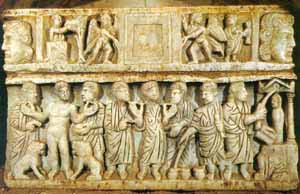
Sarcophagus of the Bambino, Roman catacombs
The same may be said of the practical disappearance of statues as opposed to icons over large areas of the Orthodox Church. The lingering memory of the Iconoclasts encouraged reticence and the Moslem conquest froze Orthodox art in its most limited form. In the conquered areas the Church was driven indoors, bells were proscribed, and the externals of Christian worship were forbidden in public. While all representations of creatures were banned for Moslem, and pressure put on Christians to conform as much as possible the icon survived while the statue could not. Only in Russia was the Church free enough to maintain its full aesthetic devotional tradition
Northern Russian woodcarving was highly developed before the coming of the Orthodox missionaries and it survived and was “baptized” into the service of the Church. All images, statues and icons, were carefully watched by ecclesiastical authority as in a ukase of the Holy Synod on March 15, 1722. From the Revolution of 1918 until after World War II statues of historical value suffered the destruction directed at all religious monuments, but currently concern for the achievements of the Russian past has focused money, attention and research on all ancient art and Orthodox statues are especially valued
Hundreds of examples of these devotional objects were destroyed in the first phase of the Revolutionary anti-religious campaign. Yet many statues and three-dimensional crucifixes are plentiful and still in use
The 1920’s discovered the Orthodox painted icon, the 1970’ the Orthodox statues
It appears the sometimes heated "two dimensional vs. three dimensional image" argument could be another example of culture intruding upon the faith
O Lord Jesus Christ, Son of the Living God, have mercy upon me, for I am a sinner
In Christ I remain His servant

 رد مع اقتباس

المفضلات