
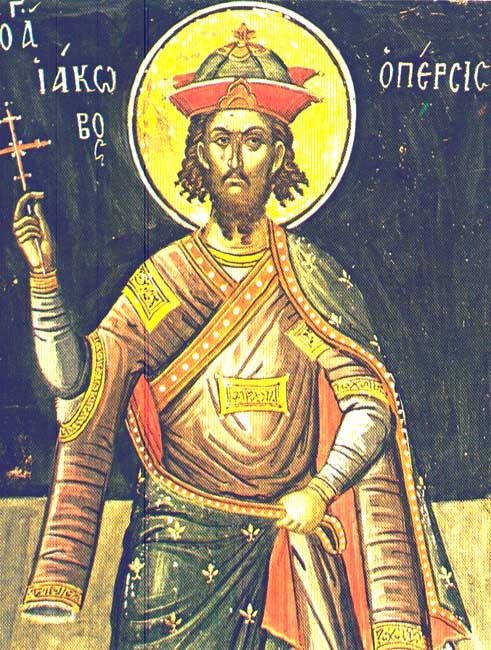
 Saint James was born and raised, it seems, in Persia (Iran). He came from a wealthy, noble family, known for its generosity and hospitality, and was a Christian. At that time, Christianity was despised and persecuted in Persia. Faced with a choice between his faith in the Lord Jesus Christ and gaining favor with the king, James chose worldly privileges and glory, becoming a partner of the king in idolatry.
The news of James's fall reached the Christians and struck them like a thunderbolt, especially since James was one of their pillars. Then James's mother and wife informed him that they were severing all ties with him because he had chosen a fleeting life over the love of Christ and the promise of eternal life.
Jacob awoke from his drunkenness and wept bitterly. His sole concern was to atone for his betrayal of the Lord of Heaven and Earth, even with blood if necessary.
Therefore, he openly professed his faith in the Lord Jesus and renounced idols. He did so at every opportunity until the king himself came forward. The king summoned him and questioned him about the truth of the matter, and he confessed without hesitation. For a time, the king seemed unbelieving, but Jacob persisted. Yazdegerd tried to tempt him with positions, wealth, and glory, but he remained unmoved. He offered him even half his kingdom, but he wouldn't listen. He reminded him of his youth and the pleasures of life, but he wouldn't budge. He threatened him, but he was indifferent. At that point, the king lost his temper and, in a fit of rage, handed him over to be tortured. The punishment was to be cut to pieces until he breathed his last.
 The king wished to summon the entire city to witness this horrific spectacle. Then the executioners began carrying out the sentence, cutting off his fingers and toes, then his arms and legs. As James suffered excruciating pain, he cried out to the Lord Jesus, “Help me, Lord!” Power from God came upon him, rendering him unaffected by the pain, as if it were inflicted upon someone else. Finally, the executioner beheaded him, and the flow of suffering ceased. James then faithfully completed his testimony and atonement.
Tradition tells that when the executioner cut off his thumb, he said, “This is how the vine is pruned so that it may grow anew in its season.” When he cut off his next finger, he said, “Accept, O Lord, the second branch of Your planting.” When he cut off the third, he said, “I bless the Father, the Son, and the Holy Spirit.” When he cut off the fourth, he said, “O You who accepted praise from the four, accept the pain of these four fingers.” With the fifth, he said, “May my joy be as great as the joy of the five virgins imprisoned.” And so it was with each finger cut, a prayer and praise to God. With the sixth, he said, “Glory to You, O Lord, who stretched out Your pure hands on the cross at the sixth hour and made me worthy to offer You my six fingers.” With the seventh, he said, “Like David, who praised You seven times a day, so today I praise You with my seven fingers severed for Your sake.” With the eighth, he said, “You, O Lord, rested on the eighth day.” And on the ninth: “At the ninth hour, O Christian, I entrusted your soul into the hands of your Father, and I give thanks to you for this ninth finger pain.” Finally, when the executioner cut off his last finger, he said: “I sing to you, O Lord, on a ten-stringed lyre, and I bless you because you have deemed me worthy to endure the cutting off of the fingers of two hands for the sake of your Ten Commandments written on tablets of stone.”.
James was martyred in the city of Babylon on the Euphrates River in the year 425 AD. The Church commemorates him on November 27.
Troparia in the fourth tune
Your martyr, O Lord, through his struggle, received from You the imperishable crown, O our God, for he gained Your strength and shattered the oppressors, and crushed the powerless might of the demons. Through his intercessions, O Christ our God, save our souls.
Qandaq with the second tune
O steadfast one, you yielded to your wise wife, fearing the terrible judgment, so you, Jacob, cast aside the fear of the horse, and appeared as a wondrous martyr when your body was cut like a vine.