
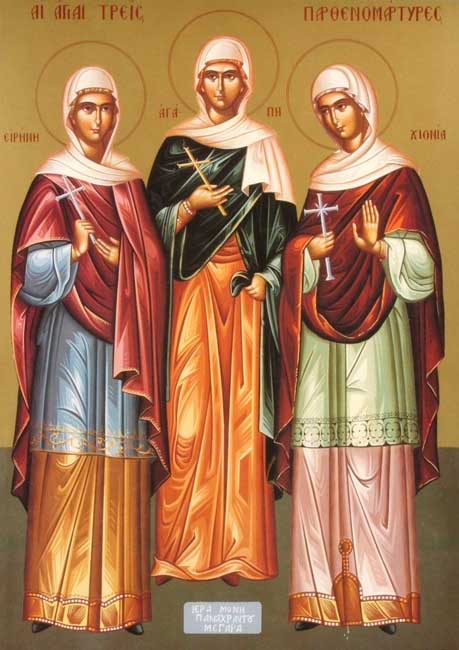
 These virgins lived during the days of the Roman Emperor Diocletian (284-305 AD). They were sisters in the flesh from the city of Thessalonica, daughters of noble parents. Since they were for Christ, they left their homeland when the spark of persecution of Christians was ignited. They came to a mountain near a lake and were accompanied by an old priest named Zoilus.
During the persecution of 295 AD, Saint Chrysogonus fell and was beheaded near the lake where the three sisters were hiding. By divine revelation, the priest Zoilus learned the location of the saint’s remains, so he went out and collected the remains, including the skull, and hid them in his cell. After thirty days had passed, Saint Chrysogonus appeared to him and announced: “Know, Zoilus, that the infidel emperor has learned of the matter of the three sisters and will seek to kill them within nine days. And behold, his mother Anastasia is coming to encourage them to martyrdom. Prepare them and you for the life to come, for you will join us in a few days to enjoy the sweetest fruits of your labors.” Anastasia also saw this vision.
Anastasia went with joy and haste to the hermitage of Zoilus, where she met the virgins. After adoring the relics of Chrysogonus, she took them to another place and prepared them for martyrdom. After a few days, the priest Zoilus died in peace.
It was not long before the virgins were arrested, after the death of their spiritual father Zoilus. Doleistius tried to win the three girls over to him by flattery, promising them to marry them to rich men and to bestow upon them generous gifts if they would honor the idols, but they refused and resisted. Then he wanted to corrupt them, and at night he got drunk and was filled with lust, so he went out alone to the prison where the sisters were being held. But the Lord God willed that Doleistius should enter the section of the prison reserved for the kitchen utensils, there he imagined that the earthen pot was the same maidservants of God, and as soon as he embraced it his face turned black with soot. When he wanted to return to the Caesar, no one noticed that he was the governor; everyone thought he was possessed, and some laughed at him. When he came to his senses, he blamed the Christians, whom he accused of practicing witchcraft. This made him even more angry with the sisters, so he ordered them to be taken out into the streets naked. When the soldiers began to carry out his order, the sisters' undergarments became as hard as leather and they could not tear or remove them. All this made Dulcitius appear in the eyes of his master to be unfit for the task, so he replaced him with another named Sisinnius. After this threat and intimidation, Agape and Chionia were condemned to death by burning. Then Agape and Chionia were thrown into the fire and gave up their souls. Anastasia came and took their remains. As for Irene, she did not submit to this. She remained steadfast in her faith.
He kept Irene in the hope that he would get her back when she saw what would happen to her sisters. Then he asked Irene to offer sacrifices to the idols, and when she refused, the governor ordered her to be sent to a brothel. On the way, an angel of the Lord appeared in a soldier's uniform and took her to a high mountain. The governor and his soldiers tried to get Irene back, but failed. Finally, one of the soldiers shot an arrow and hit her in the chest, so she joined her sisters. Saint Anastasia also came and took her remains.
The names of the three saints who joined them were Cassia, Philia, and Eutyches, in addition to a young man named Agathon.
The church celebrates their feast on April 16.
Troparia for the bar in the fourth tune
Your martyrs, O Lord, through their struggle, have received from You, O our God, imperishable crowns, because they have attained Your power and have crushed the usurpers and crushed the powerless might of the demons. Through their supplications, O Christ God, save our souls.