
Rejection of infant baptism among Baptists
Baptists completely reject “infant baptism,” and do not consider it real or regular baptism. This is his “theological and literary background,” according to them, that “God did not
Baptists completely reject “infant baptism,” and do not consider it real or regular baptism. This is his “theological and literary background,” according to them, that “God did not
Baptists admit that they “do not agree with each other” in the smallest details, and that they do not have a “Baptist doctrine,” or a “historical Baptist belief.”
In a public debate with Jehovah's Witnesses (1), I asked them something similar to what I am asking now, and they asked me, saying: Don't you depend on
The idea that the Orthodox Church adheres to the principles and piety of the ancient, universal, indivisible Church is the central principle of this Church.
It is clear that the Old Testament foreshadowings point not only to the event of Christ’s crucifixion, but also to the sign of the cross itself, the “sign of the Son of Man,” which will be the banner of victory at the Lord’s triumphant coming. The cross of the Lord is an expression of God’s infinite love and of man’s infinite value. There is no greater expression of God’s love than the cross, and there is no greater elevation of man than his elevation to the reality of the cross.
The truth of salvation in Christ is not a rigid letter that can be preserved in a book. It is a treasure that the Lord gave to the apostles so that their union would be the sure guarantee of their possession of the truth of salvation. The apostles passed this treasure on to the bishops so that they might complete the mission, in their union with the Church - the Body of Christ, where the Holy Spirit works. In doing so, they do not express their own opinion, but the will of the Holy Spirit who dwells in the Church.
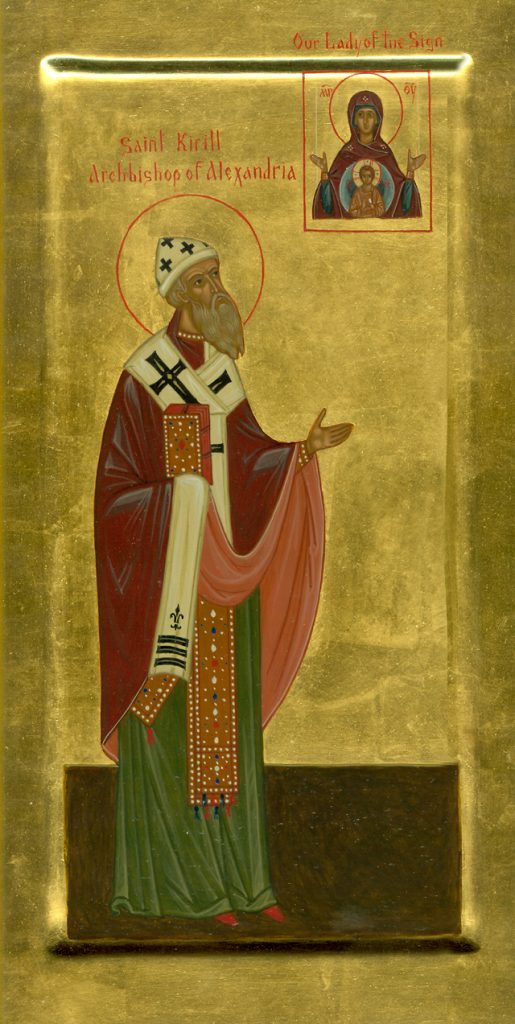
Saint Cyril was born in the city of Alexandria around the year 378. His uncle, the Archbishop of Alexandria, Theophilus, took responsibility for his upbringing and education.
Man cannot know the divine truth, that is, he cannot know the essence of God, but only knows the uncreated actions of God, that is, His effects. However, the Church tradition and the Holy Bible speak of specific appearances of God, the most important of which was His appearance to Abraham in the form of three angels. The Church Fathers say that this event is the first appearance of the Holy Trinity in the Old Testament.
The Church is of course “apostolic,” but it is also patristic. It is essentially the “Church of the Fathers.” These two “characteristics” cannot be separated, and because it is “patristic,” it is truly “apostolic.” The witness of the Fathers is more than a historical feature, more than a voice from the past.
“آباء الكنيسة” لم يتصرفوا كأفراد فقط، بل كرجال كنسيين، بالنيابة عن الكنيسة وباسمها. فهم الناطقون باسم الكنيسة ومفسِّرو إيمانها وحافظوا تقليدها وشهود حقيقتها وإيمانها ومعلِّمون بارزون، وعلى هذا الأساس يقوم سلطانهم!
The problem of the correct interpretation of the Bible remained acute until the fourth century during the Church’s conflict with the Arians, and it did not lessen in intensity than it was in the second century during the resistance of the Gnostics, the Sabalians, and the Montanists. All parties to the conflict resorted to the Bible, to the point that the heretics cited—and still do—its chapters and verses and resorted to its authority.
Christ himself belongs to this community as its head, not only as Lord and Master. He is not above the Church or outside it, for the Church is in him. The Church is not merely a community that believes in Christ and walks in his footsteps or according to his commandments, but rather the community that resides in him and in which he resides through the Holy Spirit.